

Total Cost of Ownership for a Quality Sofa: What to Compare Before You Buy
The lower-priced sofa may not be the less costly choice over time. The total cost of ownership for a quality sofa includes more than its purchase price. Delivery, care, possible repairs and eventual removal may also affect what you spend while you own it.
Start with the price, but don’t assume that a higher price guarantees better durability or lower costs later. A sofa that feels right in a showroom may not suit your HDB flat or condo, your household routine or the route into your home. Separate confirmed costs, such as a listed purchase price, from estimates and unknowns, such as future repairs.
A practical comparison looks at purchase and delivery costs, stated upholstery and care details, functions, dimensions and access. It also considers how your household will use the sofa. This approach won’t predict every future expense, but it will help you compare options using the information available and your plans for the home.
Key Takeaways
- Compare sofas over the same ownership period and include the same cost categories for each option.
- Use the total cost of ownership for a quality sofa to weigh documented costs alongside estimates and unknowns, not to turn assumptions into facts.
- Compare evidence such as materials, care instructions, functions and dimensions before drawing conclusions about value.
- Measure your room and delivery route, then consider how your household will use the sofa day to day.
- Use features such as the Aura 87211 Sofa’s adjustable elements or the Alladin 87186 Sofa’s Aquaclean® fabric as comparison points, not promises of lower ownership costs.
Why a Sofa’s Purchase Price Does Not Show Its Total Cost of Ownership
Sofa total cost of ownership (TCO) is the purchase amount plus relevant costs of owning the sofa over a period you choose. Depending on the sofa and your circumstances, costs may include delivery, care, repairs, replacement or disposal. The Total Cost of Ownership (TCO) overview on Wikipedia explains the broader principle: the initial purchase price is only one part of the costs associated with owning an item.
This comparison is useful because price alone doesn’t establish how long a sofa will last or whether it offers better value. A lower price doesn’t automatically mean lower ownership costs either. The result depends on the specific product information and the costs your household may face. Treat TCO as a way to organise what you know, what you can reasonably estimate and what remains unknown, rather than a precise prediction of the future.
For a Singapore home, practical fit is part of the decision. The sofa’s dimensions, shape and functions should suit the room and your household routine. Its delivery route should work too. A sofa that doesn’t fit through the access route or leaves too little space to move around can create practical problems that its price tag doesn’t show.
What belongs in a household sofa ownership comparison?
Start with the confirmed purchase amount for each sofa. Add delivery and other applicable charges only when you have reliable details. A delivery fee shown for your order is a known cost. A possible future repair bill without an assessment is not. Keep confirmed amounts separate from estimates so the comparison doesn’t imply more certainty than you have.
- Known: the purchase amount and any documented delivery or other applicable charges.
- Estimated: possible care or repair costs based on a stated plan or relevant quote.
- Unknown: future replacement costs or disposal charges that haven’t been established.
Resale value is also uncertain unless you have reliable evidence for the specific sofa and circumstances. If you can’t support an amount, leave it out or label it unknown instead of counting on it to lower the comparison total.
Why a quality label is not a cost calculation
“Quality” is a reason to ask questions, not a calculation. Look for stated materials, construction details, functions, care instructions and dimensions. These product attributes can help you judge whether a sofa suits your needs. A broad claim such as “built to last” doesn’t tell you how your household will use it, what care it may need or what ownership will cost.
Keep evidence separate from expectation. A documented feature may help you assess suitability, but it doesn’t prove a longer lifespan or lower costs. This article doesn’t predict any sofa’s lifespan. Compare the details available for each option, and explore RitzHouzz sofas with the same careful lens: fit, stated features and relevant costs, not the label alone.
How to Calculate Total Cost of Ownership for a Quality Sofa
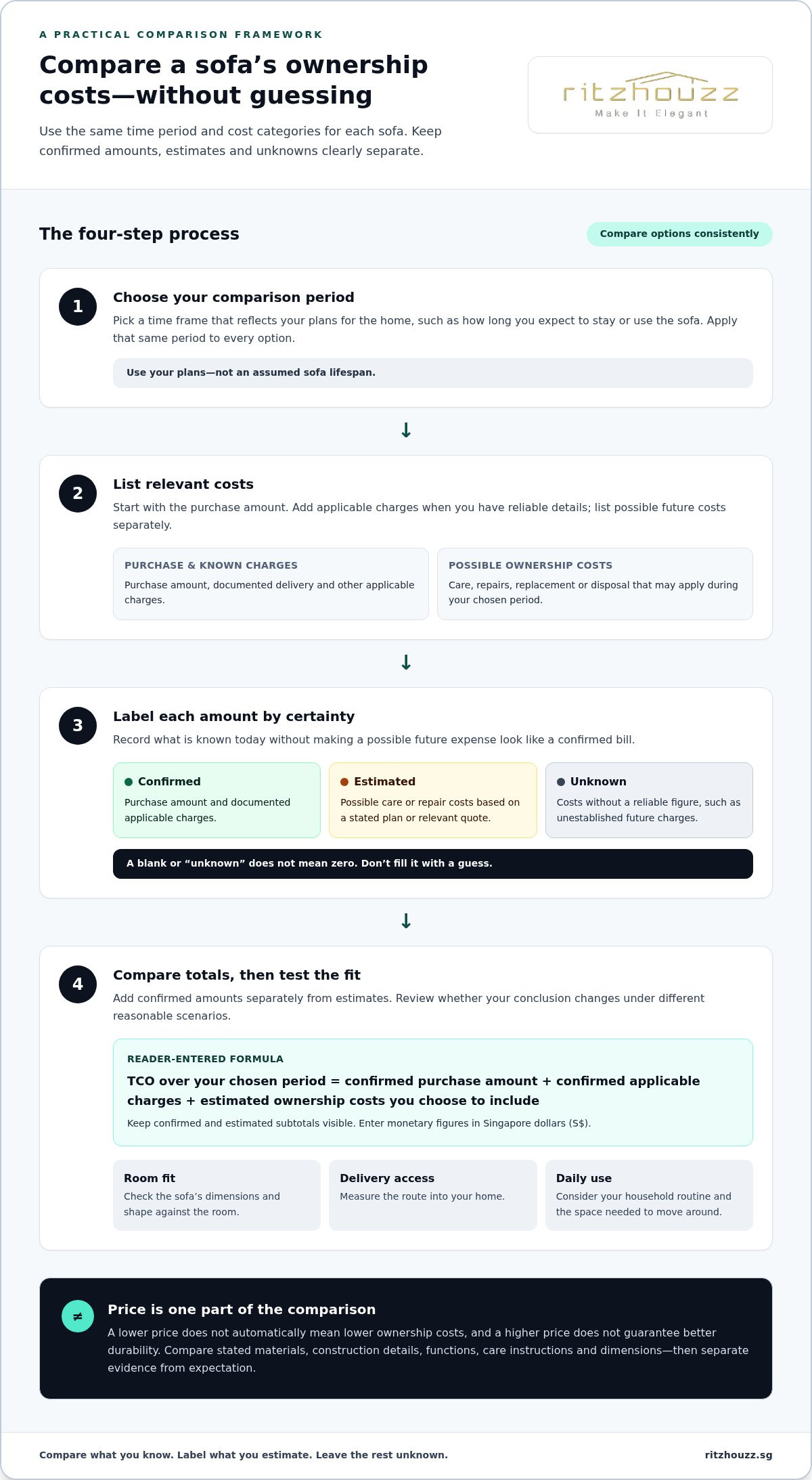
A useful comparison doesn’t require an exact forecast of what each sofa will cost years from now. It needs a consistent method that makes confirmed amounts easy to compare and clearly labels future possibilities. Use this four-step process to calculate the total cost of ownership for a quality sofa using your own information.
- Choose a comparison period. Pick a time frame that reflects your plans for the home, such as how long you expect to stay or use the sofa. Apply the same period to every option.
- List relevant costs. Record each sofa’s current purchase amount, then add delivery or other charges only when their amounts are known. List care, repairs, replacement or disposal separately if they may apply during your chosen period.
- Label each amount by certainty. Mark documented amounts as confirmed. Put future care or repair figures in an estimate column, and label costs without a reliable basis as unknown. Don’t make an unknown look precise by entering a guess.
- Compare the totals. Add confirmed amounts separately from estimates. Then review whether your conclusion changes under different reasonable scenarios.
Build a fair comparison using costs you can verify
Use current product information or a quotation for each sofa’s purchase amount. Add delivery and other applicable charges only when the amount and its relevance to your order are clear. Keep future maintenance, repair or replacement figures outside the confirmed-cost total unless they are established. This shows what you know today without presenting a possible future expense as a bill you will certainly pay.
A simple worksheet can use one row per sofa and the same columns for each: purchase amount, known delivery and other charges, estimated care, estimated repairs, possible replacement or disposal, and unknowns. Enter monetary figures in Singapore dollars (S$). Leave a cell blank or mark it “unknown” when you don’t have a reliable figure. A blank does not mean zero.
Reader-entered formula: TCO over your chosen period = confirmed purchase amount + confirmed applicable charges + estimated ownership costs you choose to include. Keep confirmed and estimated subtotals visible so their different levels of certainty are clear.
Choose a period without assuming a sofa’s lifespan
Your comparison period should suit your plans, not an advertised or assumed lifespan. If you may move or change your living arrangement, choose a period that helps you assess that decision. If you’re unsure how long you’ll keep the sofa, compare more than one scenario, using the same period for every option in each scenario. Treat future repairs, replacement or disposal as possibilities, not facts.
Using the same period and cost categories matters. Changing them between sofas can make the totals misleading, even when every calculation is correct. Once your worksheet is ready, you can enquire about sofa options that suit your room and comparison criteria.
Quality Sofa vs Lower-Priced Sofa: Compare Evidence, Not Assumptions
A higher-priced sofa isn’t automatically the better long-term choice, and a lower-priced option doesn’t automatically cost more to own. For a fair comparison, record what the product information actually says, note the current purchase amount and keep possible future expenses separate unless you have a relevant estimate. Neither price tier guarantees a particular service life or lower total cost of ownership.
Use the comparison below as a worksheet. Product features are evidence about what a sofa offers, not proof of durability or savings. Enter current amounts from the information for the specific option you’re considering. If a detail or figure isn’t available, mark it unknown rather than filling the gap with an assumption.
Which product details can meaningfully distinguish two sofas?
Compare stated upholstery and care characteristics, then consider whether listed functions suit your household’s intended use. Check product dimensions against your living-room layout and delivery access, particularly in a compact HDB flat or condo. A function matters when you’ll use it. Extra features alone don’t establish better value. Compare transparent details rather than broad “premium” or “budget” labels.
For example, the Aura and Alladin have different documented details. Those features can help you assess suitability, but they don’t establish either model’s lifespan or future costs. Review RitzHouzz sofa options using the same evidence-led approach.
How to treat repair, upkeep, and replacement estimates
Don’t assign cleaning or repair costs without a relevant, verifiable estimate for the sofa and work involved. If you don’t have one, leave the amount unknown. You can compare possible future costs as separate scenarios, but label them clearly as estimates, not facts. Assumptions from commercial office furniture or specialised outdoor collections from MIMO Living reflect very different wear and weather conditions, so they aren’t a sound default for an indoor household sofa.
Paying more makes sense only when the documented benefits matter to your home and routine, and the confirmed cost fits your plans. If a feature or material doesn’t address a real need, its presence alone doesn’t prove it will improve value over time.
A Practical Sofa TCO Checklist for Singapore Homes
Before comparing figures, check that each sofa is a realistic option for your home and household. In an HDB or BTO flat, resale flat, or condominium, room proportions and the route from the entrance to the living area can determine whether a sofa is practical. Gather these details first, then compare the total cost of ownership for a quality sofa using consistent information.
Check fit, access, and household use before comparing totals
- Measure the intended area. Note the available width and depth, and consider how the sofa will sit alongside existing furniture. Leave room for everyday movement rather than measuring only the sofa footprint.
- Trace the delivery route. Consider the entrance, corridor, turns and lift, where relevant. Compare these spaces with the sofa’s stated dimensions and configuration to identify possible access constraints before purchase.
- Consider how the household will use it. Think about who will use the sofa and which functions are genuinely useful in daily life. A feature adds practical value when it suits both your routine and the room.
- Read the care information. Note the stated upholstery and care instructions for each option. Don’t assume similar-looking materials need identical care.
- Record applicable charges. Use current product information or a quotation for the purchase amount and any known delivery or other charges. Keep unconfirmed future expenses separate.
Configuration matters as much as dimensions. An L-shaped sofa, modular arrangement or sofa bed may suit one household’s layout and routine, but consider its measurements and intended use before comparing it with a more compact option. Explore the RitzHouzz sofa range with these practical criteria in mind.
Create a clear ownership-cost worksheet
Set up one column for each sofa and use the same cost rows and ownership period for every option. Add a status beside each entry: confirmed, estimated or unknown. Record where each figure or product detail came from, such as current product information, a quotation or a care document. That makes it easier to revisit an estimate or correct a detail without losing track of what is verified.
- Purchase: enter the current confirmed amount in S$.
- Delivery: include a charge only if it applies and its amount is known.
- Upkeep and repair: add relevant estimates only when supported by information for the sofa and work involved.
- Replacement and disposal: record a reliable figure if you have one; otherwise mark it unknown.
Keep notes on dimensions, access and intended use beside the cost worksheet. A lower total won’t make an unsuitable sofa a better fit for your home. If you’ve gathered your measurements and requirements, enquire about suitable sofa options with RitzHouzz.
Explore RitzHouzz Sofas Through a Clear Ownership-Cost Lens
Once you’ve identified your room dimensions, household needs and verifiable costs, apply the same comparison framework to sofa options from RitzHouzz. Consider each model’s documented features and how they relate to your everyday use. A function or fabric may help you decide whether a sofa suits your preferences, but it doesn’t establish a lower total cost or a particular lifespan.
Use documented sofa features as comparison inputs
The Aura 87211 Sofa has a push-back function, adjustable headrest and adjustable wing armrests, and it can convert to a bed-like position. These details may matter if you value adjustable seating or a convertible position. Assess each function against how you expect to use the sofa, without treating it as a saving or a prediction of future maintenance.
The Alladin 87186 Sofa has a push-back function and Aquaclean® fabric, which is water-based stain-resistant, easy-clean technology from Spain. Include these stated details in your comparison, then consider them alongside care information and costs you can verify. The description alone doesn’t determine what upkeep your household will need.
Both the Aura 87211 Sofa and Alladin 87186 Sofa are listed at $2,288.00 SGD. That makes the comparison especially useful for considering their different features and fit, rather than assuming one costs less to buy. Shipping cost is calculated at checkout. Consider each sofa’s dimensions and how your household will use its functions. A feature you value can inform your choice without needing to justify itself through an assumed financial return.
RitzHouzz also offers furniture customisation. For a made-to-measure sofa, your room measurements and preferred configuration can help define what matters in the comparison. Keep the same practical questions in view: does the sofa suit your layout, will it work with the access route, and are the relevant charges clear? If future care or repair costs are unknown, leave them that way rather than using them to rank one sofa above another.
Make the next step a practical product enquiry
Before discussing sofa choices, prepare a few useful details: the area available, access measurements that may affect delivery, who will use the sofa and which features matter most. You can also note your preferred upholstery or configuration and any cost information you’ve gathered. These requirements make it easier to discuss options in the context of your home rather than comparing a label or price in isolation.
You don’t need to predict future ownership costs before making an enquiry. Bring your criteria and questions, then consider which sofa options suit them. To discuss your requirements with RitzHouzz, visit the contact page or enquire about sofa options directly.
Choose with Confidence for the Home You Have
A sofa decision is about more than the amount on a receipt. The total cost of ownership for a quality sofa brings your budget, living space and plans for your home into one considered choice. Your comparison doesn’t need to predict every future expense. It should help you see what you know, what you’re estimating and which practical qualities matter to your household.
Before taking the next step, note your room measurements, how the sofa will be used and which features you value. You can then discuss options in the context of your home rather than choosing by price tier alone. RitzHouzz’s Aura 87211 Sofa and Alladin 87186 Sofa have distinct functions and upholstery details to weigh against your priorities. These are product attributes, not promises of savings or longevity.
Ready to explore a sofa that fits your requirements? Share your room measurements and enquire about sofa options with RitzHouzz. Your space and preferences are a practical starting point for choosing with confidence.
Frequently Asked Questions
How do you calculate the total cost of ownership for a sofa?
Use a worksheet for the exact sofa configuration and add the purchase amount to relevant expenses within your chosen period. Check that each product quote refers to the same number of seats and options; otherwise, you may be comparing different purchases. Keep dated copies of product information and quotations so you can refer to the details and charges used in your calculation. The result is a planning figure for your circumstances, not a guaranteed forecast.
Is a more expensive sofa always cheaper to own over time?
No. Consider whether the added spend buys a feature or fit you’ll genuinely value. Someone who rarely uses a reclining function may place little value on it, while another household may use it often. Also consider how much room the sofa occupies in its usual and extended positions. This helps you weigh its practical usefulness rather than assuming a higher price guarantees lower ownership costs.
What costs should I include when comparing two sofas?
Include the purchase amount and delivery charges tied to the specific order, along with any relevant care or end-of-use expenses for your circumstances. Check that the quote applies to the selected size and configuration, and note any stated delivery-access conditions. In a Singapore flat or condo, the route through the lift, corridor and doorway may affect what you need to clarify about delivery before deciding.
Can I calculate sofa ownership cost without knowing how long it will last?
Yes. You can assess costs over a practical planning period, such as the time before a move or room renovation, without claiming that it represents the sofa’s full life. Read the result as a decision aid for that period, not a lifetime cost or replacement prediction. If you keep the sofa beyond that point, your actual ownership costs will continue to change.
How should I compare sofa maintenance costs if they are not listed?
Compare the care tasks described in each sofa’s own instructions rather than assigning an unsupported dollar amount. Note whether the guidance involves routine care you can manage at home or suggests professional attention, and don’t assume similar-looking upholstery has identical requirements. “Easy-clean” doesn’t necessarily mean there will be no maintenance expense. Keep that distinction in mind when considering each sofa’s care needs.
Does a sofa’s resale value belong in a total cost of ownership calculation?
It can be considered if you have a sound basis for estimating proceeds, but an online asking price doesn’t show what a comparable sofa actually sold for. Consider the model, condition and age when assessing relevant completed sales. If you include a possible resale amount, also account for known costs directly involved in selling it, and compare the result with a scenario that assumes no resale proceeds.
Disclaimer
The information in this article is provided for general guidance only and is intended to help readers make informed decisions about mattresses, furniture, renovation, carpentry and related home solutions. Product specifications, prices, promotions, availability, warranties and services may change without notice. Actual colours, materials, dimensions and comfort may vary from images or descriptions. For renovation, carpentry or space-planning projects, final recommendations, measurements, scope of work and quotations should be confirmed directly with RitzHouzz before proceeding. Mattress comfort and suitability are subjective, and any health-related information is general in nature and should not be treated as medical advice. Please contact RitzHouzz or visit our showroom for the latest product and service information.