

Pocketed Spring Mattress Benefits for Couples and Comfort
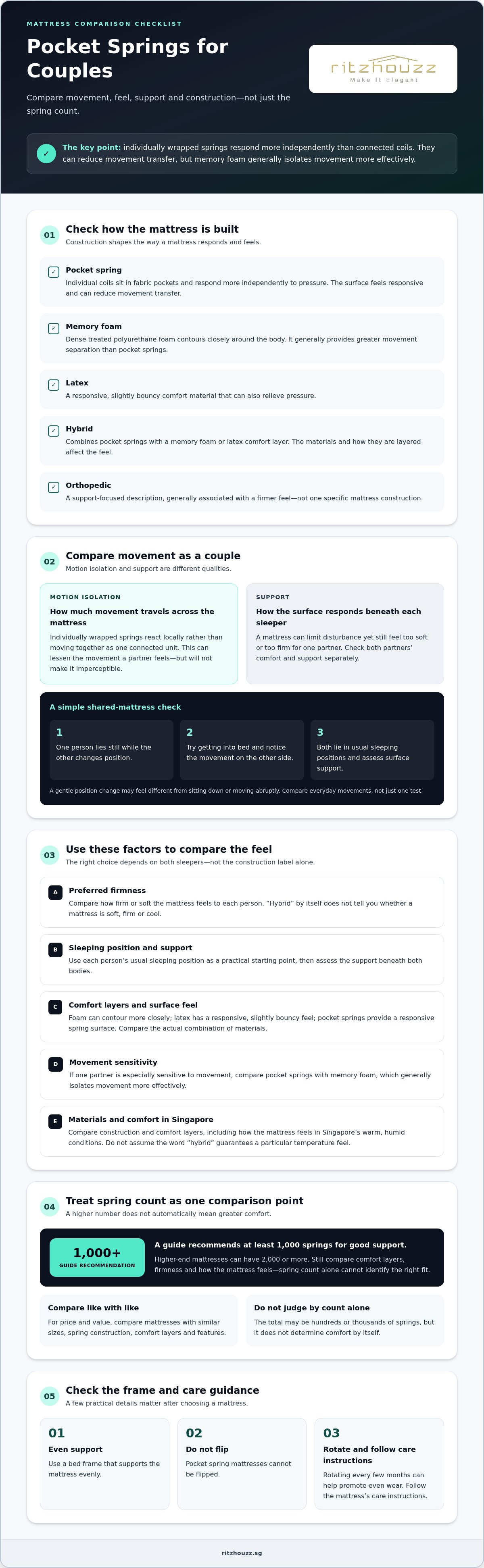
More springs do not automatically mean greater comfort. A pocket spring mattress is an innerspring mattress with individual springs enclosed in fabric pockets. Each spring responds more independently to movement than coils in a connected unit. Couples may value pocketed spring mattress benefits such as reduced movement transfer and a responsive feel, although memory foam generally isolates movement more effectively.
Choosing a mattress together can be a balancing act: one partner may move during the night, while both want a comfortable, supportive surface. The right choice depends on more than spring construction. Consider firmness, comfort layers, sleeping positions and how sensitive each of you is to movement. This article explains how pocket springs work, compares them with foam and hybrid options, and explores support, airflow and fit for couples in Singapore, so you can decide whether they suit your shared preferences.
Key Takeaways
- Learn how individually wrapped springs differ from connected coils, and how that construction compares with foam, latex and hybrid mattresses.
- Consider how much movement reaches a partner when choosing between pocket springs and the closer-hugging feel of memory foam.
- Use sleeping position and preferred firmness as practical starting points when comparing mattress support.
- Understand how independently responding springs can follow body movement while retaining a responsive feel.
- Compare mattress construction and comfort layers to find an option that feels suitable in Singapore’s warm, humid conditions.
What Is a Pocket Spring Mattress?
A pocket spring mattress is an innerspring mattress with individual coils enclosed in fabric pockets. Its feel depends on the springs, comfort layers, firmness and your sleeping position.
Pocketed Spring Construction
Each coil sits in its own fabric pocket, and the pockets join to form the spring unit. Unlike traditional interconnected coils, individual springs respond more independently to pressure. A mattress may contain hundreds or thousands of springs, but the total alone does not determine comfort. Memory foam, by contrast, is dense treated polyurethane foam that contours around the body.
That contouring can provide pressure relief, while pocket springs create a more responsive surface. For couples, the spring design can reduce the sensation of a partner’s movement, although memory foam generally isolates movement more effectively. Neither construction suits every sleeper, so compare how each feels in your usual sleeping position.
Pocket Springs Combined With Foam or Latex
A hybrid mattress combines pocket springs with a comfort layer of memory foam or latex. It pairs the springs’ responsive support with foam’s closer contouring or latex’s springier feel. The result depends on the materials and how they are layered, so “hybrid” alone does not tell you whether a mattress feels soft, firm or cool.
Memory foam is often described as contouring to the body and reducing pressure points. Latex mattresses feel responsive and slightly bouncy while also relieving pressure. An orthopedic mattress is generally defined by its support purpose and firmer feel, rather than by one specific material construction.
| Option | Construction | Feel and comparison |
|---|---|---|
| Pocket spring | Individual coils in fabric pockets | Responsive; reduces movement transfer |
| Memory foam | Dense treated polyurethane foam | Contours closely; greater movement separation |
| Latex | Latex comfort material | Responsive, slightly bouncy pressure relief |
| Hybrid | Pocket springs with foam or latex | Combines spring response with a comfort layer |
| Orthopedic | Support-focused description | Often firm to extra-firm |
Compare firmness, surface feel, materials and how much movement separation you prefer.
How much do pocketed spring mattresses cost in Singapore? Prices vary with mattress size, spring construction, comfort layers and brand. Compare mattresses with similar materials and features to assess their value.
What are the disadvantages of pocketed spring mattresses? Pocketed springs and memory foam can feel different in how they respond to movement, so consider how much motion separation you prefer. Their feel also varies by model, so spring count alone will not identify the right mattress.
What pocket spring count or coil density should I look for? A guide recommends at least 1000 springs for good support, while higher-end mattresses can have 2000 or more. Treat count as one comparison point alongside comfort layers, firmness and how the mattress feels.
Do pocketed spring mattresses need a specific bed frame or regular maintenance? Use a bed frame that supports the mattress evenly, and follow its care instructions. Pocket spring mattresses cannot be flipped; rotating one every few months can help promote even wear.
Motion transfer and suitability for couples
When sharing a mattress, one person’s movement can reach the other. Individually wrapped springs can reduce that transfer while preserving a responsive feel, making motion isolation and support useful qualities to assess together.
How do pocketed spring mattresses reduce motion transfer between partners? Each spring sits in its own fabric pocket and responds more independently to weight and movement. When one partner turns, nearby springs react locally rather than moving as one connected unit, which can lessen the sensation on the other side.
Motion Isolation for Mattress Sharers
Motion isolation describes how much movement travels across a mattress. Pocketed spring mattress benefits for couples can include reduced disturbance and a responsive spring feel. Memory foam generally isolates movement more and contours more closely, so compare both constructions if one partner is especially sensitive to movement.
Try a simple comparison together: one person lies still while the other changes position or gets into bed. Notice the movement you feel and the support beneath each body. This helps distinguish motion isolation from comfort. A mattress may limit disturbance but still feel too soft or firm for one partner.
Reduced Partner Motion Disturbance
Individually wrapped springs can reduce partner disturbance because movement in one area does not make every coil respond together. For example, if one sleeper shifts near the edge, springs beneath the other sleeper remain more independent than in a connected-coil design. This can reduce movement transfer, but will not make movement imperceptible.
Weight and the force of a movement also affect what each person feels. A gentle position change may feel different from someone sitting down or moving abruptly. Compare these everyday movements on a mattress, then pause in your usual sleeping positions to see whether the surface feels steady to both of you.
Support and motion isolation describe different qualities. Motion isolation concerns movement travelling across the mattress; support concerns how the surface responds beneath each sleeper. Couples should assess the particular mattress rather than assume every pocket spring model feels alike.
For a practical comparison, have each partner lie on their usual side. Take turns changing position while the other stays still. Then compare with memory foam: both can provide minimal movement transfer, but foam generally separates movement more and has a closer, body-hugging feel. Pocketed spring mattress benefits may appeal more to couples who prefer spring response to close contouring.
Couples seeking greater movement separation may prefer memory foam’s closer contouring. Those who want a springier feel can test pocket springs together. Notice how a partner’s turn feels, whether both sleepers feel supported, and whether the mattress responds comfortably to everyday movement before deciding.
Support for different sleeping positions
Pocket springs respond beneath the sleeper’s body, while firmness and zoning shape the overall feel. Compare these features with your usual sleeping position, not spring count alone.
How can I choose the right firmness and size of a pocketed spring mattress in Singapore? Start with your sleeping position and preferred feel, then test the mattress in your usual posture. Singapore Queen measures 1520 × 1900 mm, while Singapore King measures 1830 × 1900 mm.
Personalised Support From Individually Wrapped Springs
Individually wrapped springs respond to pressure separately, allowing different parts of the mattress to react to each sleeper’s weight and shape. This differs from a connected spring unit, where coils move together more readily. The construction can provide targeted pressure relief without requiring both sides to feel identical, although comfort layers and firmness also affect the result.
Zoned Support Options
Zone designs vary in how they distribute support. A three-zone mattress separates support for the head, body and legs; five zones offer more tailored support. Seven- and nine-zone designs divide the surface further, aiming to respond to different body areas. More zones do not automatically mean greater comfort or durability, so judge the feel in your usual position.
Firmness, Pressure Relief, and Edge Support
Pocketed spring mattresses can provide consistent firmness across the surface while individual springs respond to pressure points. Some models include edge support, which can make more of the mattress usable and help sleepers feel steadier near the sides. Test the edge by sitting and lying near it. Foam mattresses may feel different because they contour more closely.
Sleeping position is a useful starting point, not a strict rule. Side sleepers can compare pocket spring, memory foam or hybrid options with a plush top. Back sleepers can try medium-firm pocket spring, hybrid or latex mattresses. Stomach sleepers may prefer a firmer pocket spring or latex surface. In each case, notice whether the mattress feels supportive without excessive pressure.
If you and your partner have different preferences, both of you should test the same surface. One can lie on their side while the other tests back sleeping, then each can compare firmness and pressure relief. This gives you a clearer picture than choosing by a label alone, especially when one partner prefers a softer feel.
Before buying in Singapore, check mattress dimensions against the bed frame and bedroom layout. Try lying in your usual position and moving naturally; note how the centre and edges feel. These practical checks offer an excellent starting point for comparing support, comfort and everyday use.
How individually wrapped springs respond to body movement
Each pocket spring responds to the weight and shape pressing against it. This local response lets the surface adapt as a sleeper changes position.
Accommodation of Different Body Types
Individually wrapped springs compress according to the pressure applied, so different areas can respond differently beneath one sleeper. For example, the shoulders and hips press differently from lighter areas. The spring unit responds to those variations rather than relying on every coil moving together. Firmness and comfort layers still shape the overall feel, so spring construction alone will not determine the right fit.
Pressure Relief and Body Contouring
Body contouring means the mattress follows the sleeper’s outline, while pressure relief describes how the surface responds at contact points. Pocket springs can contour without restricting movement as much as memory foam may. Foam offers a closer, body-hugging sensation; pocket springs feel more responsive. Compare both by lying in your usual position and noticing pressure around your shoulders and hips.
Movement changes the load on a mattress. When someone turns from their back to their side, pressure shifts across the surface. Pocket springs respond individually to that changing weight rather than requiring the whole spring unit to move as one. This creates a more adaptive feel than connected-coil construction.
That responsiveness can suit sleepers with different body shapes, but it does not make every pocket spring mattress feel the same. A firmer model may resist compression more, while a softer comfort layer can change how the springs feel beneath the body. Compare the surface and support together, not just the spring unit.
During a showroom test, lie still first, then turn onto your side and back. Notice whether the mattress follows the change without feeling restrictive. Check whether your shoulders and hips feel cushioned and the rest of your body feels supported. Repeat the test on a foam mattress to compare its closer contouring with spring response.
A mattress should also let you move naturally. Pocket springs can follow body contours without limiting movement in the way memory foam sometimes can. If you change position often, pay attention to how readily you can roll and settle again. The comfort layer may influence this sensation as much as the springs.
Pressure relief depends on more than a premium label or a high spring count. Consider your preferred firmness, sleeping position and how the surface responds beneath you. For example, side sleepers can focus on shoulder and hip comfort, while back sleepers can assess whether the mattress feels evenly supportive.
Make the comparison practical: test the same position on each mattress, then change posture and move naturally. This helps distinguish a responsive spring feel from foam’s closer contouring. Choose the surface that offers a comfortable balance of movement, firmness and pressure relief for your body.
Breathability and temperature regulation
In Singapore’s humid climate, airflow through a mattress can influence how warm its surface feels. Pocket springs leave space around the coils, allowing air to move through the spring unit more readily than through dense foam.
Each spring sits independently inside its fabric pocket rather than forming part of a solid foam block. This construction encourages airflow through the spring layer as sleepers move or change position. It may help hot sleepers feel cooler, although the comfort layers also shape the sleeping surface.
Those layers matter. A pocket spring mattress may include foam or other cushioning above its coils, and a thicker, closer-contouring layer can feel different from a more open surface. For example, a hybrid mattress pairs pocket springs with memory foam or latex. Assess the whole construction, not just the spring unit, when comparing breathability.
Memory foam contours closely to the body, which can make it feel more enveloping than pocket springs. Heat retained by memory foam may disrupt sleep and increase wakefulness. Someone who tends to sleep hot may prefer a pocket spring mattress, while a person who often feels cold may appreciate memory foam’s closer feel.
Latex offers another point of comparison. Latex mattresses are described as cooler than foam, with a responsive, slightly bouncy feel. If you are choosing between latex and a pocket spring design, compare how each feels against your body. The spring unit allows airflow between coils; latex provides a different surface response.
For couples, airflow and movement transfer are separate considerations. Individually responding springs can promote airflow while also limiting how much movement travels across the mattress. A foam comfort layer may change the contour and surface warmth without removing the spring unit beneath it. Compare both features, especially if one partner sleeps warmer.
Use a simple showroom test: lie on each mattress long enough to notice its surface feel, then change position. Compare a pocket spring model with a memory foam or hybrid option. Notice whether the layers feel close and warm or more open and responsive. This direct comparison is more useful than relying on the mattress category alone.
Singapore’s warm, humid conditions make breathability a practical factor alongside support and durability. Pocket spring and hybrid mattresses can be comfortable options because they balance support, durability and breathability. Still, the comfort layers and your own temperature preferences determine which surface feels suitable.
Choose based on your usual sleep experience: hot sleepers can start by comparing pocket springs, while those who feel cold can try memory foam. If you share a bed, test the mattress together and consider airflow, contouring and movement transfer as distinct qualities. A side-by-side trial helps show which construction feels comfortable to both partners.
RitzHouzz: Aura 87211 Sofa
For readers comparing pocket spring mattresses, RitzHouzz offers various options to explore. Judge each by how it feels to you, rather than assuming its name indicates a particular firmness or construction.
Testing mattresses in person can help you compare comfort and support against your own sleeping preferences. Explore the RitzHouzz mattress range and visit the showroom to try suitable options side by side.
Contact RitzHouzz with questions about comparing mattresses and choosing a model for your household.
Choose a mattress that suits both of you
Make your next step a shared mattress comparison. Discuss what matters most to each of you, then test options that reflect those preferences. The pocketed spring mattress benefits you prioritise may differ, so agree on the feel and support you both want before deciding.
A showroom visit lets you compare mattresses together and consider how each feels in your usual sleeping positions. Take time to discuss your impressions, especially if you and your partner prefer different firmness levels.
Contact RitzHouzz to ask about comparing mattresses and planning your next step.
Frequently Asked Questions
What are the main benefits of a pocketed spring mattress?
Its individual springs respond separately, which can reduce movement transfer while retaining a springy feel. This can suit couples who want some motion separation without memory foam’s closer contour. Firmness and comfort layers vary by model, so compare mattresses in person. For a practical test, have one partner turn while the other lies still, then switch roles and discuss the movement each person notices.
Do pocketed spring mattresses provide better spinal support and pressure relief?
They can provide responsive support and pressure relief, but “better” depends on your body, sleeping position and preferred firmness. A mattress should feel supportive without creating uncomfortable pressure at contact points. For example, side sleepers can focus on shoulder and hip comfort, while back sleepers can assess whether the surface feels evenly supportive. These comfort features do not make a mattress a treatment for back pain.
Are pocketed spring mattresses more breathable and suitable for Singapore's hot, humid climate?
Spaces around pocket springs allow airflow through the spring unit, which may help the mattress feel cooler. In Singapore’s warm, humid conditions, also consider the comfort layers: close-contouring foam may feel different from a more open surface. Compare the complete mattress rather than the springs alone. If you tend to sleep hot, lie on the mattress and notice how its surface feels after settling.
How durable are pocketed spring mattresses, and how long do they typically last?
Individual pocket spring mattresses may last up to 8-10 years, depending on construction, use and care. Rotate the mattress every few months to encourage more even wear, and follow its care instructions. Pocket spring mattresses generally cannot be flipped, so rotation is the relevant routine. Check periodically for visible sagging or a change in how the surface feels, and reassess comfort as your needs change.
How do pocketed spring mattresses compare with traditional innerspring, memory foam, and hybrid mattresses?
Pocket springs are an innerspring design, but each coil sits in its own fabric pocket rather than moving as part of an interconnected unit. Traditional connected coils may feel more unified; memory foam contours more closely and usually isolates movement more effectively. A hybrid combines pocket springs with foam or latex, pairing spring response with a different comfort-layer feel. Compare firmness, movement response and contouring in the same sleeping position.
Disclaimer
The information in this article is provided for general guidance only and is intended to help readers make informed decisions about mattresses, furniture, renovation, carpentry and related home solutions. Product specifications, prices, promotions, availability, warranties and services may change without notice. Actual colours, materials, dimensions and comfort may vary from images or descriptions. For renovation, carpentry or space-planning projects, final recommendations, measurements, scope of work and quotations should be confirmed directly with RitzHouzz before proceeding. Mattress comfort and suitability are subjective, and any health-related information is general in nature and should not be treated as medical advice. Please contact RitzHouzz or visit our showroom for the latest product and service information.