

High-Quality Sofa Buying Guide: What to Look For
What if the sofa that looks most impressive in a product photo isn’t the one that feels right at home? Details that affect durability and everyday comfort, from the frame and suspension to the cushions and upholstery, are often hidden from view. Knowing what to look for in a high-quality sofa means looking beyond its silhouette and considering how it is made, how it feels and how it will work in your home.
Choosing well can be difficult when comfort, durability and appearance all matter, especially in an HDB flat or condo where space and delivery access can narrow your options. This guide shows you how to assess construction and finishing, compare seating and upholstery for your household’s needs, and measure the room and access route before deciding. It also covers care requirements, Singapore’s humid climate and the way you plan to use the sofa, from daily lounging to accommodating guests.
Key Takeaways
- A polished appearance alone cannot tell you how a sofa is built or how it will feel in everyday use.
- Assess the frame, joints, suspension and cushions together, rather than relying on one feature.
- Compare upholstery and seating feel against your household’s comfort and care priorities.
- Measure the room, circulation space and delivery access before choosing a sofa for an HDB flat or condo.
- Match product features to your routine and the space available, not just to the look you prefer.
What to look for in a high-quality sofa
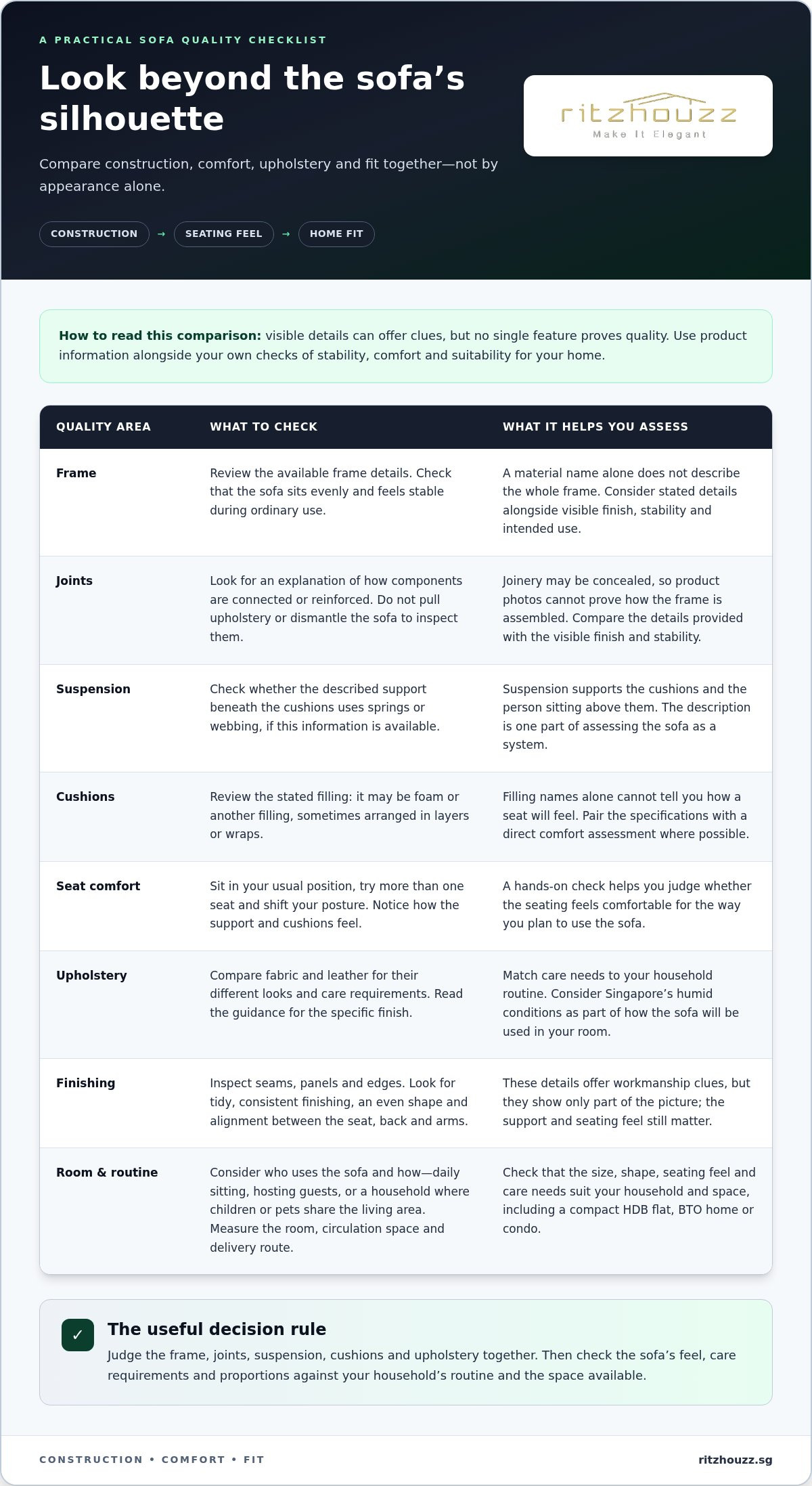
Look at construction, comfort, upholstery, finishing and fit as a whole. Check that the sofa sits evenly, inspect visible seams and alignment, and try the seat in the positions you use at home. Then compare the upholstery care guidance with your household’s routine and measure both the room and the route into it. No single feature proves quality; the useful choice is the one whose construction details, feel and proportions suit your needs.
What makes a high-quality sofa more than just good-looking?
Sofa quality is the balance of sound construction, lasting comfort, considered materials, careful finishing and suitability for the home it serves. A striking shape or refined upholstery can catch your eye, but a photograph cannot show how the frame is joined, how the cushions respond when you sit or whether the sofa suits your routine. Appearance matters, but it is not proof of quality.
Assess what you can see alongside what you can experience. Consider how the sofa feels, whether its upholstery fits your care preferences and how its proportions work in your room. In HDB flats, BTO homes and condos, living areas can be compact, so the right choice should suit the space rather than overwhelm it.
Which signs matter beyond a sofa’s appearance?
Look for even seams, neatly aligned panels and a consistent shape. These details offer clues about workmanship, but they show only part of the picture. The frame and support beneath the cushions are less visible, while the cushion filling and upholstery affect the feel and care requirements. No single detail tells the whole story.
A sofa works as a system: the structure supports the seating, the cushions shape the feel, and the upholstery forms the surface you live with. The Upholstery overview explains how covering materials and construction contribute to a finished piece. When comparing sofas for different homes, consider how these elements work together instead of assuming one frame material or design is best for everyone.
- View the sofa from different angles and check that it looks stable and evenly aligned.
- Inspect seams, joins and edges for tidy, consistent finishing.
- Consider whether the upholstery and cushion shape suit how you plan to use the sofa.
How should your household shape the quality checklist?
A sofa’s demands depend on who uses it and how. A household that sits together each evening may value a different seat feel from someone who mainly uses the sofa to host guests. If children or pets share the living area, cleaning needs may carry more weight. Decide what your household needs before comparing upholstery options.
Think about how much regular care you are comfortable with. Fabric and leather have different looks and care requirements, so compare the guidance for the specific finish rather than choosing by colour alone. Singapore’s humid conditions are another reason to consider the room and everyday use. Ask yourself:
- Who will use the sofa most often, and for what activities?
- How much time do you want to spend caring for the upholstery?
- Will the sofa’s size, shape and seating feel suit the room and household?
These answers turn a broad search into a practical checklist. Use them to judge whether a sofa’s construction, comfort and finish suit the way you live, not simply the way it looks in a product photo.
How to assess sofa frames, joints, suspension and cushions
A sofa’s support comes from several parts working together. The frame carries the structure, the joints connect it, and the suspension supports the cushions and the person sitting above them. Consider these elements as a system instead of judging a frame material or one construction detail in isolation.
Product descriptions and photos can offer clues, but they may not show every internal detail. If specifications are provided, use them to understand the sofa’s construction, then assess its visible finish and stability. No single material or construction method guarantees a sofa will suit every home or feel comfortable to every person. Look for consistency between the stated details, visible workmanship and your own assessment.
What can you inspect about a sofa’s frame and joints?
When sitting normally or gently shifting position, notice whether the sofa feels steady and its visible parts stay aligned. Look across the arms, back and seat for an even, balanced appearance. If part of the underside or frame is already accessible, inspect the visible finish without pulling upholstery, forcing components or dismantling anything.
Joinery may be concealed, so a product photo cannot prove how the frame is assembled. Read the construction details provided and look for an explanation of how components are connected or reinforced. A material name is useful, but it does not describe the whole frame. Consider any quality claims alongside visible finish, stability and suitability for your intended use.
- Check that the sofa sits evenly and feels stable during ordinary use.
- Look for consistent alignment between the seat, back and arms.
- Review available frame and joinery details without disturbing the upholstery.
How do suspension and cushions affect everyday comfort?
Suspension is the support beneath the cushions. It may use springs or webbing, while cushions can contain foam or other fillings, sometimes in layers or wraps. These choices affect how the seat responds, but the material name alone cannot tell you whether it will feel right. Use the available information alongside a direct comfort assessment.
If you can assess a sofa in person, sit in your usual position rather than taking a quick perch. Try more than one seat, shift your posture and notice whether the support and cushion feel comfortable for how you plan to use the sofa. Check whether the seat depth lets you sit naturally and whether standing up feels easy for you. A softer or firmer feel is a personal preference, not a universal quality ranking.
To make what to look for in a high-quality sofa more concrete, assess the frame, joints and suspension together, then judge the cushion feel for yourself. To compare designs and seating features, browse the RitzHouzz sofa range.
How to compare sofa comfort and upholstery without relying on appearance
Start with your routine, not a fabric swatch or a price tag. A heavier sofa or a more expensive finish is not automatically better made or more comfortable. Review the upholstery description, care requirements and seat feel separately, then weigh them against how the sofa will be used.
Fabric and leather have distinct looks and feels, but the exact finish and care guidance matter. RitzHouzz upholstery options include Easy Clean, Aquaclean Carabu, Half Leather and Full Leather/Genuine Leather. The Alladin 87186 Sofa features Aquaclean® fabric, water-based stain-resistant, easy-clean technology from Spain. These details can help you compare care preferences, but they do not establish how long a sofa will last or whether it will feel right to you.
| What to compare | Questions to consider |
|---|---|
| Fabric | Does the texture and appearance suit your home? What care does the specific fabric require? |
| Leather | Do you prefer its surface and feel? Which care instructions apply to the selected finish? |
| Seating feel | Does the seat feel comfortable for sitting upright, relaxing or both? |
| Care priorities | Are you comfortable with the routine needed to keep the upholstery looking the way you prefer? |
Which upholstery option suits your care preferences?
Decide how much attention you want to give to upkeep and which surface feels right in your living room. Compare the specific care guidance for each option instead of assuming all fabric or leather behaves alike. If stain resistance or easier cleaning matters to you, look for a clearly stated feature such as Aquaclean® technology. Do not treat that feature as a claim about overall durability.
How can you judge comfort for your own routine?
Comfort is personal. If you can try a sofa, sit upright and recline as you would at home. Notice whether the seat depth suits you, whether the back gives the support you prefer and whether the arm position feels natural. Try different seats if available. There is no universal ideal firmness or posture.
Use these observations alongside upholstery and care preferences to make a balanced comparison. A finish that suits your household may matter more than the softest seat, while your preferred lounging position may make seat depth and back support decisive. The question of what to look for in a high-quality sofa is best answered by matching stated features with your own comfort and maintenance priorities. Compare RitzHouzz sofa options with those criteria in mind.
What to check before choosing a sofa for your room
A sofa can suit your taste and still feel awkward in the room if it blocks a walkway or cannot pass through the entrance. In an HDB, BTO, resale flat or condominium, check both the space where it will sit and the route it must take to get there. Measuring both helps you compare configurations before deciding.
How do you measure for a sofa that fits?
Measure the available area, then mark the proposed footprint on the floor with tape or paper. Include space for people to pass, reach nearby furniture and use doors comfortably. For a reclining or extending design, account for its open position too. Room fit is only half the check: measure the delivery route from the entrance to the intended room.
- Measure the room. Note wall lengths, corners, door swings and fixed features that may affect placement.
- Mark the sofa footprint. Use the model’s stated dimensions to map its full width and depth, including any chaise or return.
- Plan circulation. Walk around the marked shape. Make sure it does not obstruct a main path or access to frequently used areas.
- Check the intended layout. Consider how the sofa relates to other furniture and whether its orientation suits the way you use the room.
- Measure access points. Check doorways, corridors, lift access and turns along the delivery route, not just the living-room entrance.
- Allow for movement. If the sofa reclines or extends, confirm there is space for it to open without interfering with nearby furniture or walkways.
Measure narrow points at their tightest and note anything that could limit manoeuvring, such as a turn or low overhead area. Compare the route measurements with the sofa’s dimensions and configuration before deciding.
Which daily-use details belong on your checklist?
Consider how the household will use the seating. A sofa for everyday shared lounging may need a different layout from one used mainly for occasional guests. Think about how many people usually sit together, whether you host often and whether children or pets affect your upholstery and cleaning priorities.
- Must-haves: Write down essential seating needs, preferred layout and any care requirements.
- Preferences: List colour, shape and style choices separately so they do not outweigh practical needs.
- Room conditions: In Singapore’s warm, humid conditions, consider your fabric care preferences and the space around the sofa.
With the room plan and household checklist in hand, compare what to look for in a high-quality sofa against the way you will actually use it. Enquire about sofa options with RitzHouzz and share your measurements and preferred layout.
How RitzHouzz sofas translate quality checks into real features
Construction and comfort are easier to assess when you connect each feature to your routine. The Alladin 87186 Sofa and Aura 87211 Sofa offer specific features to compare, not universal benchmarks for every sofa. Consider them alongside your room measurements, intended use and upholstery priorities.
Which confirmed features distinguish the Aura and Alladin sofas?
Both models have extra-large seating and a push-back function. The Aura 87211 Sofa also has an adjustable headrest and adjustable wing armrests, and converts to a bed-like position. These features may suit you if you value adjustability or want another position for relaxing. Include the space needed for your preferred use in your measurements.
The Alladin 87186 Sofa features Aquaclean® fabric, water-based stain-resistant, easy-clean technology from Spain. This stated upholstery feature can help you compare care preferences, but it is not a guarantee of overall durability. Your choice between the models depends on which features matter most in your home.
- Aura 87211 Sofa: push-back function, adjustable headrest, adjustable wing armrests, a bed-like position and extra-large seating.
- Alladin 87186 Sofa: push-back function, extra-large seating and Aquaclean® fabric, water-based stain-resistant, easy-clean technology from Spain.
What is a useful next step after comparing sofa quality?
Before choosing, note the sofa’s footprint and delivery route, your preferred seating positions and the upholstery care that suits your household. Then compare each model against those priorities. A feature is most useful when it meets a real need, whether that is adjustability, a bed-like position or a stated upholstery-care property.
Explore the RitzHouzz sofa collection with your room measurements in hand. Consider the sofa’s shape, scale and relationship to nearby furniture as well as its finish. This makes it easier to separate useful features from details that are simply attractive.
For a tailored comparison, share your room dimensions and priorities with the team. Enquire about sofa options for your home to discuss features that may suit your space and everyday use.
Choose a sofa that feels right for your home
Turn your shortlist into a decision grounded in your own home. Picture an ordinary evening: where people sit, how the room needs to function and what should feel effortless. This can clarify which details matter in practice, rather than leaving the decision to a product image or appealing finish.
Keep your measurements and priorities close as you make your final comparison. The question of what to look for in a high-quality sofa becomes more personal when you consider how you want the room to support everyday life. A considered choice should suit both the space and your routine.
For help comparing sofa options, share your requirements with RitzHouzz. Include your room measurements and preferred layout to make your enquiry practical and specific.
Frequently Asked Questions
Is a heavier sofa always higher quality?
No. Weight alone cannot tell you what to look for in a high-quality sofa, since it does not explain the frame, joinery, support or finishing. Treat it as one physical impression, not a verdict. A sofa may feel substantial but still not suit your preferred seating feel or room layout. Compare the construction information, stability, comfort, upholstery and fit together.
Can a sofa look well made but have weak construction?
Yes. A smooth finish and neat seams describe what you can see, but do not reveal every internal component. When comparing options online, look for product information about the frame, joints or support system instead of relying on polished photography. If those details are not shown, appearance alone cannot settle the question.
How long should a high-quality sofa last?
There is no single lifespan that applies to every sofa. Use and care make a difference: a sofa in a busy family living room may face different demands from one used occasionally. Read the care guidance, consider your household’s routine and compare the construction details provided. These factors offer a more grounded basis for judging suitability than a fixed year count.
Is a firm sofa better quality than a soft sofa?
No. Firmness describes a seating preference, not a reliable quality grade. To compare options, sit as you normally would, then change position and notice whether the seat still feels comfortable. Consider how the back and arms feel for your preferred posture. A seat that feels supportive to one person may feel too firm or too soft to another, so there is no universal ideal.
Does Singapore’s humid climate affect which sofa I should choose?
It can inform your care and room-planning preferences, but it does not make one upholstery material right for every household. Consider how the room is ventilated and used, and follow the care guidance for the specific sofa. If the living area tends to feel warm or enclosed, include airflow and cleaning preferences in your decision instead of assuming a fabric or leather finish is climate-proof.
Can I judge sofa quality from online photos alone?
Disclaimer
The information in this article is provided for general guidance only and is intended to help readers make informed decisions about mattresses, furniture, renovation, carpentry and related home solutions. Product specifications, prices, promotions, availability, warranties and services may change without notice. Actual colours, materials, dimensions and comfort may vary from images or descriptions. For renovation, carpentry or space-planning projects, final recommendations, measurements, scope of work and quotations should be confirmed directly with RitzHouzz before proceeding. Mattress comfort and suitability are subjective, and any health-related information is general in nature and should not be treated as medical advice. Please contact RitzHouzz or visit our showroom for the latest product and service information.