

Space-Saving Furniture for HDB, BTO & Condos in Singapore
What if space-saving furniture could do more than take up less room? In an HDB, BTO or condo, a sofa, bed or dining table can make a compact home feel crowded when it serves only one purpose. Choosing space saving furniture Singapore homeowners can live with comfortably starts with identifying the daily activities you want to make easier.
It is not always obvious whether a fold-away bed, a storage solution or multifunctional furniture will suit your layout. The right choice depends on your room dimensions, household routines and the clear floor area you need for moving around, not just the furniture’s footprint.
This article explains how to compare practical options, from Murphy beds and wall beds to flexible dining and living-room furniture. You will also learn what to measure, including circulation space and access into your home, before considering furniture or custom carpentry. The aim is to make your available floor area work harder without sacrificing comfort or visual calm.
Key Takeaways
- Choose space saving furniture Singapore homes can use according to the room’s everyday purpose, not appearance alone.
- Compare Murphy beds, storage-focused pieces and multifunctional options by the space they free and how often they need to be set up.
- Remember that added storage creates capacity but does not necessarily open up more floor area.
- Map room features and intended activities before measuring furniture placement and the clearances needed for use.
- For a more tailored layout, prepare your room dimensions or floor plan to discuss space planning and carpentry options with RitzHouzz.
Why Space-Saving Furniture in Singapore Starts with How You Use Each Room
A bedroom in an HDB flat might need to work as a quiet place to sleep and a work area by day. In a BTO, resale flat or condo, the challenge could be a dining area that doubles as a place for children’s activities or family visits. Homes vary, so choosing space saving furniture Singapore residents can use comfortably starts with the particular room, not a standard product list.
Space-saving furniture supports a room’s intended activities while reducing unused or obstructive space. For example, a wall bed can let a room serve as a bedroom at night and leave more open floor area during the day. The Murphy bed is one recognised form of a bed designed to fold away when it is not in use.
Which room function needs more space?
Begin by identifying what you want the room to do better. Is the priority sleeping, working, dining, hosting, storage or flexible family use? Naming the main need helps distinguish furniture that addresses the problem from a piece that simply looks compact.
Separate a storage shortage from a movement problem. If belongings have no designated place, adding storage may help organise the room. If a table, chair or bed makes it awkward to pass through or use a doorway, extra storage alone will not resolve the blocked route. Storage can increase capacity without freeing floor area.
Some rooms need to change function during the day. A spare room may be used for work on weekdays and for guests at other times. A dining table might support meals as well as household tasks. Consider which activities happen most often, what needs to stay set up, and what can be put away or reconfigured without making daily routines cumbersome.
Why the same furniture does not suit every Singapore home
An HDB, BTO or resale-flat label does not tell you exactly how a room is shaped or furnished. Condo layouts also vary. The position of windows and doors, room proportions, built-in wardrobes and other fixed features can all affect where furniture fits and how it functions.
Household routines matter just as much. A couple who regularly host guests may value flexible seating, while a household that works from home may need a surface that stays available during the day. A solution that suits one routine may add unnecessary setup for another.
Plan for access as well as placement. A piece may fit its intended room but be difficult to bring through the home’s corridor, doorway or lift. Include these routes in your planning, along with the space needed to move around the furniture when it is in use. This broader view helps keep the room practical, not merely tidy on paper.
Space-Saving Furniture Types: From Murphy Beds to Multifunctional Pieces
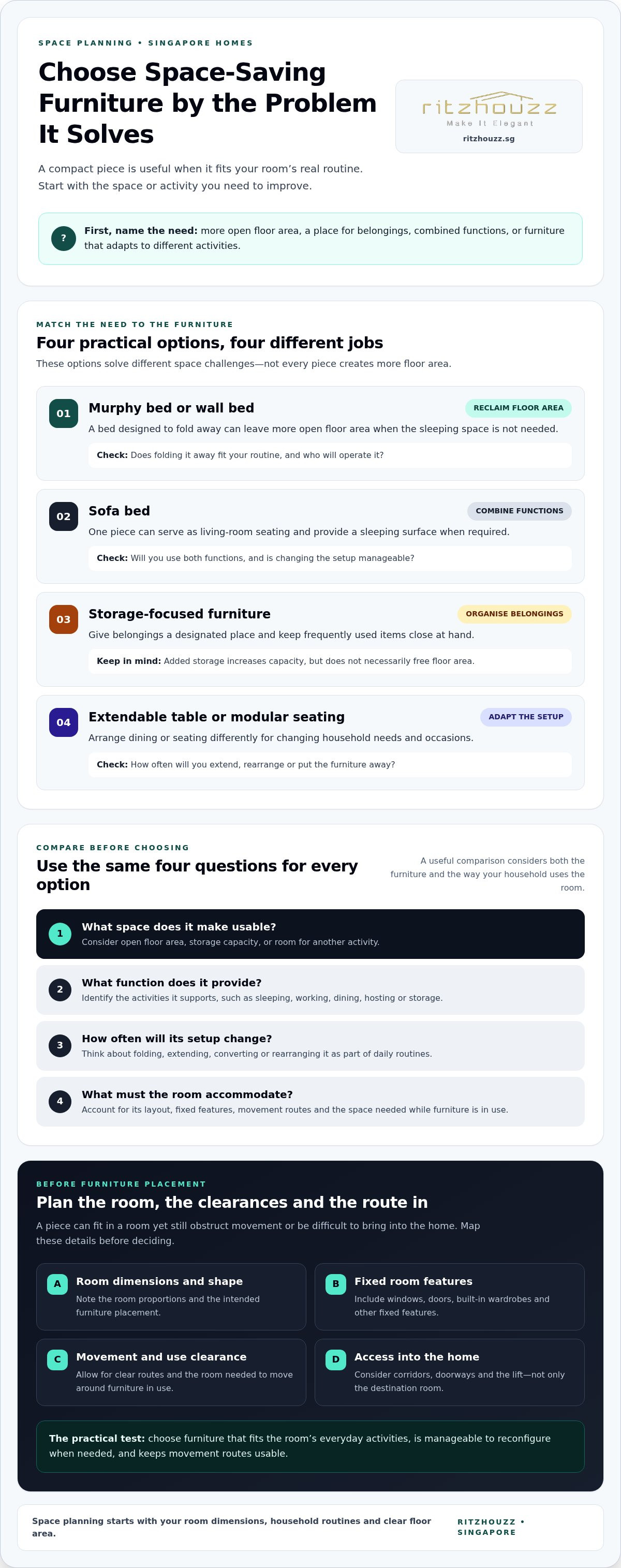
Space-saving furniture addresses different needs. Some options make a room easier to reconfigure, while others combine activities or provide adaptable seating and dining. Compare what each piece asks of your routine as well as what it offers: a flexible design is most useful when its additional function is comfortable and convenient to access.
- Reclaim floor area: A Murphy bed or wall bed can be folded away when the sleeping area is not needed.
- Combine activities: A sofa bed can serve as seating and provide a sleeping surface when required.
- Organise belongings: Storage-focused furniture gives items a designated place and can keep frequently used belongings close at hand.
- Adapt dining or seating: Extendable dining tables and modular seating can be arranged for different household needs.
Transformable furniture requires a change of setup. Consider how often you will fold, extend, convert or rearrange it, and whether those steps suit the people who use the room. Fixed furniture may be more straightforward if its function rarely changes. A flexible piece may suit a household with shifting needs, provided each configuration is practical and easy to access.
When a Murphy bed or wall bed may fit the routine
A Murphy bed or wall bed may suit a room where the sleeping arrangement needs to be put away between uses. Consider whether that change fits your household’s routine, including who will operate it and what else must be moved or repositioned. For broader ideas on modular layouts, The Straits Times shares tips for a stylish, space-efficient home with modular furniture.
Storage, multifunctional and adaptable furniture
Storage furniture gives belongings a place, while multifunctional furniture combines separate uses in one piece. A sofa bed, for example, serves as seating and a sleeping option; modular seating can be rearranged for different occasions. Think about which functions you will genuinely use and whether changing the setup is manageable. Browse sofas for different living-room needs as you consider how seating fits your layout.
When comparing space saving furniture Singapore homes may need, match each category to your household’s routine and the room’s intended uses. If you are considering a Murphy bed, wall bed or tailored storage, share your room dimensions or floor plan with RitzHouzz to discuss space-planning options.
How to Compare Space-Saving Furniture for Your Home
Compare each option against the same four questions: what space does it make usable, what function does it provide, how often will you need to change its setup, and what must the room accommodate? This gives you a clearer basis for comparing space saving furniture Singapore homes may need, without assuming one category suits every layout.
| Furniture type | Space gained | Function | Setup frequency | Planning questions |
|---|---|---|---|---|
| Wall bed | Can open floor area when folded away | Sleeping, with the room available for another activity when the bed is put away | Consider how often it will be folded away and brought back into use | Will the open and folded positions both work with the room’s layout and circulation? |
| Storage-focused piece | Adds storage capacity; may not free floor area | Keeps selected belongings in or on furniture | Usually depends on how often items are retrieved | Can you reach the storage easily without shifting other furniture? |
| Multifunctional furniture | Combines uses in one piece, which may reduce the need for separate pieces | Supports more than one activity | Depends on how often its function changes | Is each function genuinely useful, and can you access it comfortably? |
| Adaptable dining or seating | Can make the arrangement more flexible for different activities | Supports dining, seating or hosting needs | Consider how often you will extend, rearrange or reconfigure it | Is there room to use the expanded or rearranged setup? |
The best choice solves a repeated daily constraint, not simply the one that appears smallest in a product image. Suitability depends on the specific layout and how the household uses it.
Compare everyday convenience with the space gained
Frequency changes the decision. A guest bed used occasionally may be manageable even if it needs to be opened before visitors arrive. A dining surface used every day should be straightforward to access and reset. Picture the full routine: opening, folding, extending or rearranging the furniture, then returning it to its usual position. If that process feels inconvenient on a normal day, the space-saving benefit may not be worth the extra effort.
Check access to storage as part of the comparison. A storage compartment is less useful if another piece must be moved each time you need something. Compare the storage benefit with the effort required to reach it.
Check layout fit, access and household needs
Assess the furniture in every position it will occupy. Mark its open and closed footprint, then consider circulation paths, door swings, windows and existing storage. A layout that works only when a bed is folded away may not suit a room where the bed needs to stay open most of the day.
Include delivery access before choosing a large piece. Check the route through the lift, corridor and doorways, as well as the intended room entrance. A room may have space for furniture that cannot pass easily through the route into the home. Record these constraints so your shortlist reflects both daily use and practical fit.
Plan Measurements and Furniture Placement Before You Buy
A measured room plan can reveal conflicts that are easy to miss while browsing furniture. Record the room as it is, then sketch how a piece will work in each position. This helps you compare options against the actual layout of your HDB, BTO, resale flat or condo instead of relying on an estimate or product image.
What to record in a room plan
Start with the room’s shape and fixed features. Measure the walls and mark doors, windows, fixed cabinetry, power points and anything else that could affect placement. Note which way doors swing and which routes need to stay clear for everyday movement. Include the activities that share the floor area, such as sleeping, working, dining or hosting.
Use this sequence to build a practical plan:
- Sketch the room: Record its shape, wall lengths and openings, including doors and windows.
- Mark fixed features: Add built-in storage, power points and other features that affect where furniture can sit.
- Map daily activities: Note what the room needs to support and which activities happen at different times.
- Measure the placement area: Check the floor and wall space available for the furniture, including the space it needs while open, extended or in use.
- Draw both positions: Sketch transformable furniture in its open and closed positions, then check whether each arrangement leaves usable routes through the room.
- Record the delivery route: Note lift, corridor and doorway access so the furniture can be considered against the path into your home.
Do not measure only the furniture’s resting position. A wall bed, extendable table or sofa bed changes the space around it when in use. Sketching both states helps you see whether the intended layout works with door swings, windows, storage access and household movement.
When space planning or custom carpentry may help
Space planning and custom carpentry can help when a room has an unusual shape, existing built-ins limit placement, or standard storage does not suit the items you need to keep. Think through what the storage must accommodate and how often you will need to reach it. RitzHouzz provides space planning and custom carpentry to help relate storage and furniture choices to those specific routines.
Before settling on an option, compare your measurements with the room’s everyday requirements: what must remain accessible, where people need to move, and which activities share the space. If you are weighing space saving furniture Singapore options against a measured plan, share your room dimensions or floor plan with RitzHouzz to discuss space planning and carpentry for your layout. Send your room plan for a consultation.
Explore Space-Saving Furniture and Tailored Planning with RitzHouzz
A compact room rarely has just one consideration. A sleeping area may also need to support another daily activity, while a storage challenge can affect where furniture sits and how people move through the home. RitzHouzz offers space-saving furniture, including Murphy beds, wall beds and multifunctional furniture, alongside space planning and custom storage and carpentry for Singapore homes.
The most useful starting point is the room’s purpose. Consider what needs to change, what must remain in place and which activities the room should support. From there, furniture options and a tailored planning approach can be considered in relation to your actual layout.
Match the next step to the room’s challenge
If a room needs to provide a sleeping area but also serve another purpose, a Murphy bed or wall bed may be worth exploring. Consider how the room is used when the bed is open and when it is put away. If the main issue is belongings or a difficult layout, custom storage and space planning may be more relevant than adding a transformable piece.
These needs can overlap. Built-in storage may affect where a bed or other furniture can go, while a furniture choice may influence the available circulation. Custom carpentry can be considered alongside furniture planning when the room’s shape, fixed features or storage requirements call for a tailored approach. The aim is to connect each option to a need you have identified, not to add complexity for its own sake.
Prepare for a useful furniture enquiry
A clear enquiry keeps the conversation grounded in your home. Share a floor plan or room measurements, then describe the activities the space must support. You can also note:
- Furniture or built-ins that need to remain in the room.
- Storage needs, including the belongings that should be accommodated.
- Access constraints, such as lift, corridor or doorway routes that may affect delivery.
- How often the room or furniture needs to change between uses.
These details give RitzHouzz a useful basis for discussing space-saving furniture Singapore homeowners may be considering, including furniture categories, custom storage and space planning. They also help identify which questions need attention before settling on a layout or solution. A floor plan is helpful, but a concise description of the room and your requirements can also start the discussion.
Share your floor plan or room requirements with RitzHouzz to begin a tailored discussion about space-saving furniture, storage or carpentry for your home.
Make Your Next Furniture Choice With Confidence
A room plan is more than a record of measurements. It helps turn everyday frustrations into clear priorities, so you can decide what should change and what needs to stay comfortable and accessible. Before choosing space saving furniture Singapore homeowners can use well, consider which improvement would make the greatest difference to your routine rather than trying to solve every constraint at once.
That priority can guide a focused conversation with RitzHouzz about furniture, space planning or custom carpentry for your home. Share the room’s purpose, key measurements and any layout requirements, such as furniture that must remain or access routes to preserve.
Start a tailored space-planning conversation by sharing your floor plan or room requirements. Discuss space-saving furniture, storage or carpentry options for the way you use your home.
Frequently Asked Questions
Are Murphy beds and wall beds the same thing?
The labels often overlap, so compare the actual design rather than relying on the name alone. Check how the bed is stored when not in use and whether shelves or other attached elements affect how you use the surrounding area. Consider which nearby items need to be moved before opening it. These details help you judge whether the arrangement is convenient for your room, regardless of the product terminology.
Can space-saving furniture work in a room used for more than one purpose?
Yes. The key is making transitions simple enough that the room remains useful in each mode. Decide where loose items go before changing the setup, and keep the essentials for each activity together. This helps prevent a flexible layout from becoming a repeated rearranging task. Choose space saving furniture Singapore households can incorporate into normal routines, rather than a setup that works only when everything is cleared away.
How do I measure furniture for lift and delivery access?
Measure the item in its packed form where possible, not only its assembled footprint. Compare the package width, height and depth with the lift cabin, lift-door opening, corridor turns and doorway clearances along the route. Note any point where the package may need to be tilted or turned. A lift’s stated capacity alone does not show whether an item can physically pass through its doors and surrounding spaces.
What should I include in a floor plan for space-saving furniture?
Use clearly labelled measurements and state whether they are approximate or taken on site. Mark furniture that will stay separately from pieces you are considering, then label each proposed piece with its intended orientation. If you are comparing different arrangements, draw them separately instead of layering outlines that become difficult to interpret. A readable plan makes it easier to understand the proposed layout and see which measurements and furniture positions are current.
Is custom carpentry useful for space-saving furniture?
It can be useful when standard pieces leave awkward gaps or do not suit a particular storage need, but built-ins are fixed commitments. Before planning them, sort belongings by how often they are used and reserve accessible locations for everyday items. Consider whether household needs may change, since movable furniture is easier to rearrange. Custom carpentry makes most sense when a clear, lasting requirement justifies a tailored fit.
Can a small room use a wall bed and storage together?
Yes. The storage does not necessarily need to be attached to the bed. Compare an integrated arrangement with separate storage elsewhere in the room, since keeping the two functions distinct may offer more flexibility if your needs change. Decide which belongings need to be stored in the room, then avoid filling every available area by default. Aim for a useful balance between sleeping, storage and the room’s other activities.
Disclaimer
The information in this article is provided for general guidance only and is intended to help readers make informed decisions about mattresses, furniture, renovation, carpentry and related home solutions. Product specifications, prices, promotions, availability, warranties and services may change without notice. Actual colours, materials, dimensions and comfort may vary from images or descriptions. For renovation, carpentry or space-planning projects, final recommendations, measurements, scope of work and quotations should be confirmed directly with RitzHouzz before proceeding. Mattress comfort and suitability are subjective, and any health-related information is general in nature and should not be treated as medical advice. Please contact RitzHouzz or visit our showroom for the latest product and service information.