

Round Dining Table for a Small Kitchen: How to Choose the Right Fit
The tabletop may not be what determines whether a round dining table for small kitchen use will work. The chairs and the space needed to move around them can make a bigger difference to your daily routine. In a compact HDB kitchen or an open-plan dining area, even a modest table can feel intrusive if it blocks a cooking route or sits too close to nearby furniture.
A round table can make a tight layout feel easier to navigate, but it isn’t automatically the most practical choice for every household. The right fit depends on how many people usually dine there, how often you host, and how much room your chairs need when pulled out.
This guide compares round, rectangular and extendable tables by looking at their full footprint, not just the tabletop. You’ll learn what to measure before shopping, how to assess chair clearance, and when another shape may suit your kitchen better. With those details in mind, you can choose a table that feels comfortable without crowding everyday movement.
Key Takeaways
- A round dining table for small kitchen use can work well when its full footprint, including occupied chairs, suits the room.
- Map fixed features such as counters, doors and nearby furniture before deciding where a table can sit.
- Compare round, rectangular and extendable designs by how they fit your layout and household routine, rather than choosing by shape alone.
- Check chair movement, base design and the number of seats you use every day when comparing dining sets.
- RitzHouzz offers round and rectangular dining tables, dining sets and furniture customisation; your measurements can help guide the choice.
Can a Round Dining Table Work in a Small Kitchen? Start With the Room
Yes, a round table can suit some compact kitchens, but the fit depends on more than the tabletop. In an HDB flat or condo, the kitchen may share space with a dining area or a route between rooms. Consider how the table will sit alongside counters, doors and the paths people use every day.
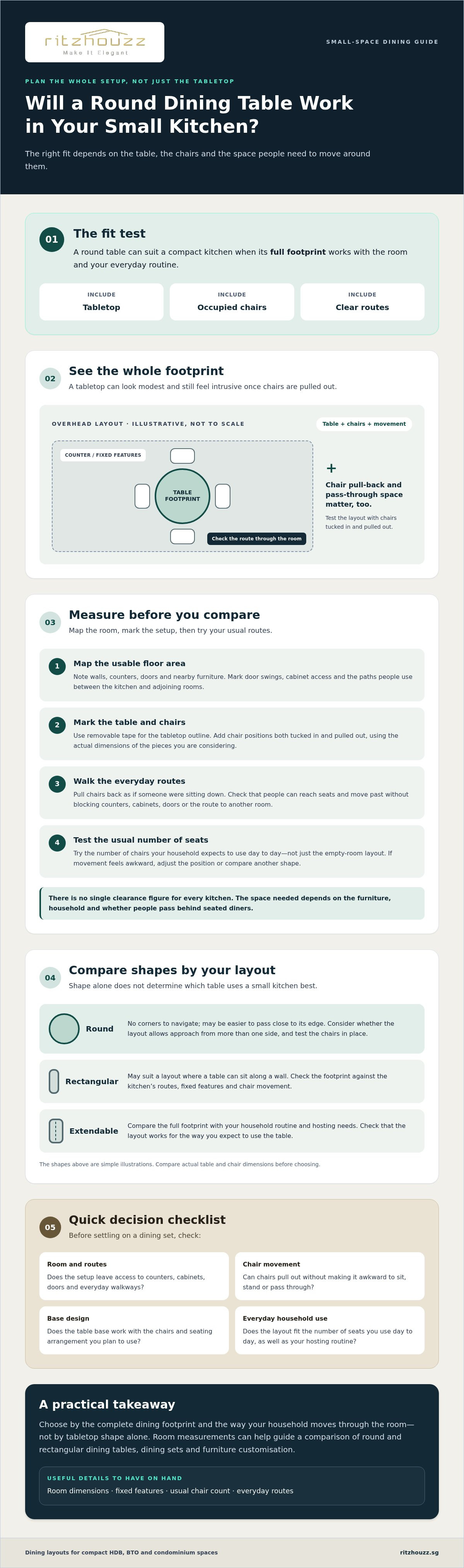
The usable dining footprint is the table plus chairs plus circulation space. Chairs need room to pull out, and people need a clear route to sit down, stand up and pass through. A tabletop that looks modest in a product photo can still feel cumbersome if occupied chairs narrow a kitchen walkway.
Think of dining as part of the room’s overall layout, rather than a separate furniture decision. A Dining room is traditionally arranged around a table and seating, but in a compact home those pieces may need to share space with kitchen work zones and circulation paths.
When a round table can make a compact kitchen feel easier to use
With no corners to navigate, a round table may make it easier to pass close to its edge. This can be useful beside a kitchen counter or in a shared dining area, particularly when the layout allows people to approach the table from more than one side.
A central position can also bring diners into conversation, since they face towards one another and can approach the table from several directions. But that arrangement needs enough room around it. A round shape doesn’t automatically take up less usable space than a rectangular one, so compare both with chairs in place.
When a round tabletop may not solve the space problem
Chairs still occupy floor space, whatever the table shape. If the kitchen is narrow, a pulled-out chair could obstruct a fixed walkway, cabinet access or the route between the kitchen and living area. In that situation, a table positioned along a wall, or a different shape, may suit the room better.
Test the setup before choosing. Mark the intended table position on the floor, then indicate where chairs sit when tucked in and pulled out. Walk the usual routes and check whether people can move without shifting furniture. This simple trial can reveal whether a round dining table for small kitchen use will support your household’s daily routine.
How to Measure for a Round Dining Table in a Small Kitchen
Measure the complete dining setup before comparing table sizes. Map the room, mark the tabletop, add the chairs in their real positions, then walk the routes you use every day. This helps you judge whether a round dining table for small kitchen use will work in practice, rather than relying on the room’s appearance or label.
Map the kitchen and the everyday routes through it
Start with the usable floor area where the table could go. Note the position of walls, counters, doors and other furniture, including anything that projects into the room. Then mark door swings, cabinet access and the paths people regularly take between the kitchen, dining area and adjoining rooms.
This approach is useful in HDB, BTO and resale-flat kitchens, as well as compact condominium layouts, where dining space may be shared with a walkway or another living area. A floor plan can help, but check the room itself too. Fixed features and furniture placement determine where the table can realistically sit.
Test the table with chairs in their real positions
Use removable tape to mark the tabletop’s intended outline on the floor. For a round top, mark a circle; a paper template can also help you picture its footprint. Next, show where each chair will sit when tucked in and when someone is seated. Use the actual table and chair dimensions once you have confirmed the specifications of the pieces you’re considering.
Now test the layout. Pull chairs back as if someone were sitting down, and walk past them along your usual routes. Check that diners can reach their seats without blocking access to counters, cabinets or doors. Repeat the test with the number of chairs your household expects to use day to day, not just with the room empty.
There’s no single clearance figure that suits every kitchen. The space needed depends on the furniture, the household and whether people must pass behind seated diners. If a route feels awkward during the tape test, adjust the proposed position or compare a different table shape before deciding.
If you’re unsure how your measurements translate to dining furniture options, share your room dimensions and requirements with RitzHouzz for guidance.
Round vs Rectangular vs Extendable Tables: Which Suits Your Kitchen?
No shape is automatically best for a compact kitchen. Compare how each option fits your room, how people reach their seats and whether the table supports your everyday routine. The table below is a starting point; the actual fit depends on the furniture dimensions and the space around it.
| Table type | Footprint | Seating access | Placement flexibility and typical use |
|---|---|---|---|
| Round | Uses floor space around its full perimeter, with no corners. | Diners can approach from several sides, depending on the surrounding clearance. | May suit a central position where access from multiple directions is useful. |
| Rectangular | Has a longer, defined footprint; chairs extend along the sides and ends. | Seating is arranged along straight edges, so check access to each chair. | May align naturally with a long or narrow dining area, or sit along a wall if the layout allows. |
| Extendable | Occupies its closed footprint day to day, with more room needed when opened. | Seating and access change with the extended setup. | May suit households that need extra dining space at times, provided the expanded table fits without blocking routes. |
Round or rectangular: compare the room layout before the look
A round table can be practical where people need to reach seats from more than one direction. A rectangular table may fit a long kitchen or dining zone more naturally, particularly if it can sit parallel to a wall without interfering with movement. For a fair comparison, mark each shape in the same proposed position and test chair access and walking routes with seats pulled out.
Consider proportion as well as shape. A compact round table may still conflict with a walkway, while a suitably positioned rectangular table could leave a clearer route. For more dining-table selection advice, see RitzHouzz’s article, “The Art of the Luxury Dining Table.”
Would an extendable table fit your household routine?
First ask how often you genuinely need extra dining space. If it is only for occasional gatherings, consider whether the table’s closed footprint suits daily use and whether there is room for it when extended.
Test both configurations on a floor plan or with removable tape. Check that the open table won’t block doors, cabinet access or the main route through the kitchen. Before buying, confirm the exact table configuration and dimensions with the retailer. RitzHouzz offers round and rectangular tables, as well as extendable dining tables, so compare the options with your room measurements and routine.
A Small-Kitchen Dining Table Checklist: Chairs, Base and Everyday Use
A dining set should suit the room with its chairs in use, not just look appealing when pushed neatly against the table. As you compare options, consider how people sit, move around the kitchen and use the dining area on an ordinary day. This check can reveal whether a round dining table for small kitchen use will work beyond a showroom or product image.
- Chair shape and size: Compare the chair’s actual width and depth with the table and available floor area. Check how far it projects when occupied.
- Chair movement: Picture each chair pulled out for someone to sit down. Confirm it won’t obstruct a nearby route, door or access to kitchen counters.
- Everyday seating: Choose for the number of people who usually dine together. Consider occasional guests separately, rather than allowing rarely used seats to crowd daily circulation.
- Table base position: Check where the base sits in relation to chair positions and legroom. Compare the confirmed product details rather than assuming a particular base design will suit.
- Room changes: Consider whether planned renovation, storage or other furniture could alter the usable floor area.
Check seating comfort and access, not just the tabletop
Compare the table and chair measurements as a set, then assess how they work in your kitchen layout. A chair that fits beneath a table when tucked in may need more room once someone sits down. Keep daily dining needs distinct from occasional hosting: an arrangement for extra guests may not be the most comfortable setup for everyday use.
Mark chair positions on the floor if you’re uncertain, then check whether someone can sit down while another person uses the nearby route. Small details matter, including whether chairs can be moved without repeatedly shifting other furniture.
Plan for delivery access and future room changes
Check the route from the home’s entrance to the intended dining area before ordering. Measure relevant doorways, turns and other tight points, and confirm the furniture’s access requirements with the retailer. In a flat or condominium, check lift access if applicable rather than assuming the route will be straightforward.
Confirm product measurements and access requirements before arranging delivery. If renovation or a change in storage is planned, reassess the dining area after accounting for the updated layout. For help assessing dining furniture options against your room measurements, contact RitzHouzz with your requirements.
Find a Round Dining Table for Your Small Kitchen With RitzHouzz
Choosing a round dining table for small kitchen use comes down to more than shape. Consider the room’s usable footprint, chair positions, everyday walking routes and how your household uses the dining area. A table that suits these details is more likely to feel comfortable in daily life, whether it sits in an HDB, BTO or resale-flat kitchen or a condominium dining space.
RitzHouzz offers dining furniture, including dining sets and round and rectangular tables, along with furniture customisation. To make an enquiry more useful, share the room layout and measurements alongside your seating needs. These details help frame the discussion around how the furniture could fit. Confirm product dimensions and available options before deciding.
What to prepare before asking about dining furniture
A few practical details can make it easier to compare suitable options:
- Room layout: Share a floor plan or describe the proposed table position, including nearby walls, counters, doors and furniture.
- Measurements: Provide the usable space and the dimensions of any fixed features that affect placement.
- Seating needs: Explain how many people usually dine together and whether you need additional seating for occasional guests.
- Access concerns: Point out narrow routes, door swings or cabinet access that must remain clear.
- Table preference: Say whether you’re considering a round or rectangular table, and ask for the relevant product dimensions and options.
This information gives the retailer useful context without assuming that a particular table will fit based on appearance alone.
Compare dining-table options with your room in mind
Ask about round and rectangular dining-table options in relation to your layout, rather than choosing by style alone. If furniture customisation may be relevant, check which dining options can be customised and what specifications are available. Confirm the product’s actual dimensions and configuration, then compare them with your room measurements and chair positions.
A measured enquiry can help you narrow the choices before making a decision. Contact RitzHouzz about dining furniture with your layout, measurements and requirements, or discuss your dining-table requirements with the team.
Choose a Table That Works With Your Kitchen
The right round dining table for small kitchen use is the one that fits your room in everyday use, not simply the one with the most appealing shape. Before deciding, consider the full footprint of the table and chairs, how people move through the kitchen, and how many seats your household regularly needs.
Compare round and rectangular options in your actual layout, and assess an extendable design both closed and open if you’re considering one. Marking the proposed positions can reveal whether chairs or an expanded tabletop would interfere with doors, counters or regular walkways. Confirm product dimensions and access requirements before arranging delivery.
RitzHouzz offers dining furniture, including round and rectangular tables, as well as furniture customisation and interior design services. Share your measurements and seating requirements to make an enquiry more specific, and ask which dining options may be customised.
Discuss your dining-table requirements with RitzHouzz. With a thoughtful room plan, you can find an option that feels comfortable and considered in your home.
Frequently Asked Questions
Is a round dining table good for a small kitchen?
It can be, if the table, chairs and circulation space fit comfortably in the room. Rounded edges may make it easier to pass close to the table, and a central position can allow access from several sides. But the shape doesn’t remove the need for chair pull-back space. Mark the intended table and chair positions on the floor, then test your usual routes before deciding.
How do I choose the right size round dining table for a small kitchen?
Choose a size by measuring the available floor area and allowing for chairs in use, rather than focusing on the tabletop alone. Mark the proposed table outline, add the chair positions, then check whether people can sit down and move through the kitchen comfortably. Compare those measurements with the confirmed product dimensions. The right round dining table for small kitchen use depends on your household and layout.
Does a round dining table save more space than a rectangular table?
Not necessarily. A round table has no corners, which may make a close passage feel easier, but it still occupies floor space around its perimeter. A rectangular table may fit a long or narrow dining area more neatly, or align with a wall if the layout allows. Compare both shapes in the same position, including chair movement and access to counters, doors and walkways.
Can I fit an extendable dining table in a small kitchen?
Possibly, if the table works in both its closed and expanded configurations. Consider how often your household needs the extra seating, then mark the larger footprint on the floor and check that it won’t block doors, cabinets or main routes. Before buying, confirm the table’s exact dimensions and extension configuration with the retailer. An extendable option is only practical if the open setup can be used comfortably.
How much space should I leave around a dining table?
A common planning reference is about 90 cm between the table edge and a wall or obstruction, with around 105 to 120 cm where people need to pass behind seated diners. Treat these figures as guidance, not a guarantee of fit. Chair dimensions, household movement and fixed features affect what feels workable, so test the setup with chairs pulled out and routes in use.
What should I measure before buying a round dining table?
Measure the usable dining area and note walls, counters, doors and nearby furniture that affect placement. Include door swings, cabinet access and the routes people use through the kitchen. Then mark the tabletop and chair positions, both tucked in and in use. Check the selected table and chair dimensions, and measure entryways and the route to the kitchen to confirm furniture access.
Are round dining tables suitable for HDB and condominium kitchens?
They can suit some HDB and condominium kitchens, but the layout matters more than the housing type. Consider whether the table sits in a separate kitchen area or shares space with a walkway or living area. Check chair movement and access to counters and doors. A floor test using the intended table and seating positions can help you judge whether a round or rectangular design better suits your home.
Disclaimer
The information in this article is provided for general guidance only and is intended to help readers make informed decisions about mattresses, furniture, renovation, carpentry and related home solutions. Product specifications, prices, promotions, availability, warranties and services may change without notice. Actual colours, materials, dimensions and comfort may vary from images or descriptions. For renovation, carpentry or space-planning projects, final recommendations, measurements, scope of work and quotations should be confirmed directly with RitzHouzz before proceeding. Mattress comfort and suitability are subjective, and any health-related information is general in nature and should not be treated as medical advice. Please contact RitzHouzz or visit our showroom for the latest product and service information.