

Memory Foam vs Latex Mattress in Singapore: 2026 Comparison Guide
A mattress that feels like an enveloping cloud in an air-conditioned showroom can quickly become a stifling heat trap at home. In the decision between a memory foam vs latex mattress Singapore sleepers often discover that our tropical climate rewrites the rules of comfort. With ambient relative humidity averaging between 80% and 84%, how a material breathes and disperses body heat matters just as much as its initial plushness.
Few things disrupt your well-being like waking up clammy at two in the morning, or struggling to shift positions because a dense comfort layer holds onto you too tightly. You deserve cool, restorative rest that maintains neutral spinal alignment without disturbing your partner. This comparison reveals how contouring viscoelastic foam and buoyant natural latex perform in local conditions, evaluating breathability, structural longevity, and practical support. Here's the essential criteria to help you choose the right sleep surface with quiet confidence.
Key Takeaways
- Understand how the contouring cradling of viscoelastic foam contrasts with the buoyant, responsive pushback of natural latex for spinal alignment.
- When evaluating a memory foam vs latex mattress Singapore homeowners must prioritize thermal regulation, noting how open-cell latex pinholes disperse nighttime warmth faster than traditional dense foam.
- Assess partner motion isolation against ease of movement to see whether pressure-absorbing foam or resilient latex suits your shared sleeping habits.
- Examine structural longevity and material weight to ensure your chosen sleep surface pairs seamlessly with reinforced bed frames or custom storage carpentry.
- Discover how pocketed spring hybrids and cooling fabric technologies provide a balanced alternative, best confirmed through thoughtful in-person showroom testing.
Memory Foam vs Latex Mattress: Key Differences and Feel
Choosing between comfort materials fundamentally shapes your sleep quality. While both surfaces aim to relieve tension, they interact with your body in opposite ways. Viscoelastic foam yields and moulds to your silhouette, whereas natural latex pushes back with lively elasticity. In the debate over a memory foam vs latex mattress Singapore homeowners quickly realize that physical feel defines nightly satisfaction just as much as aesthetic design.
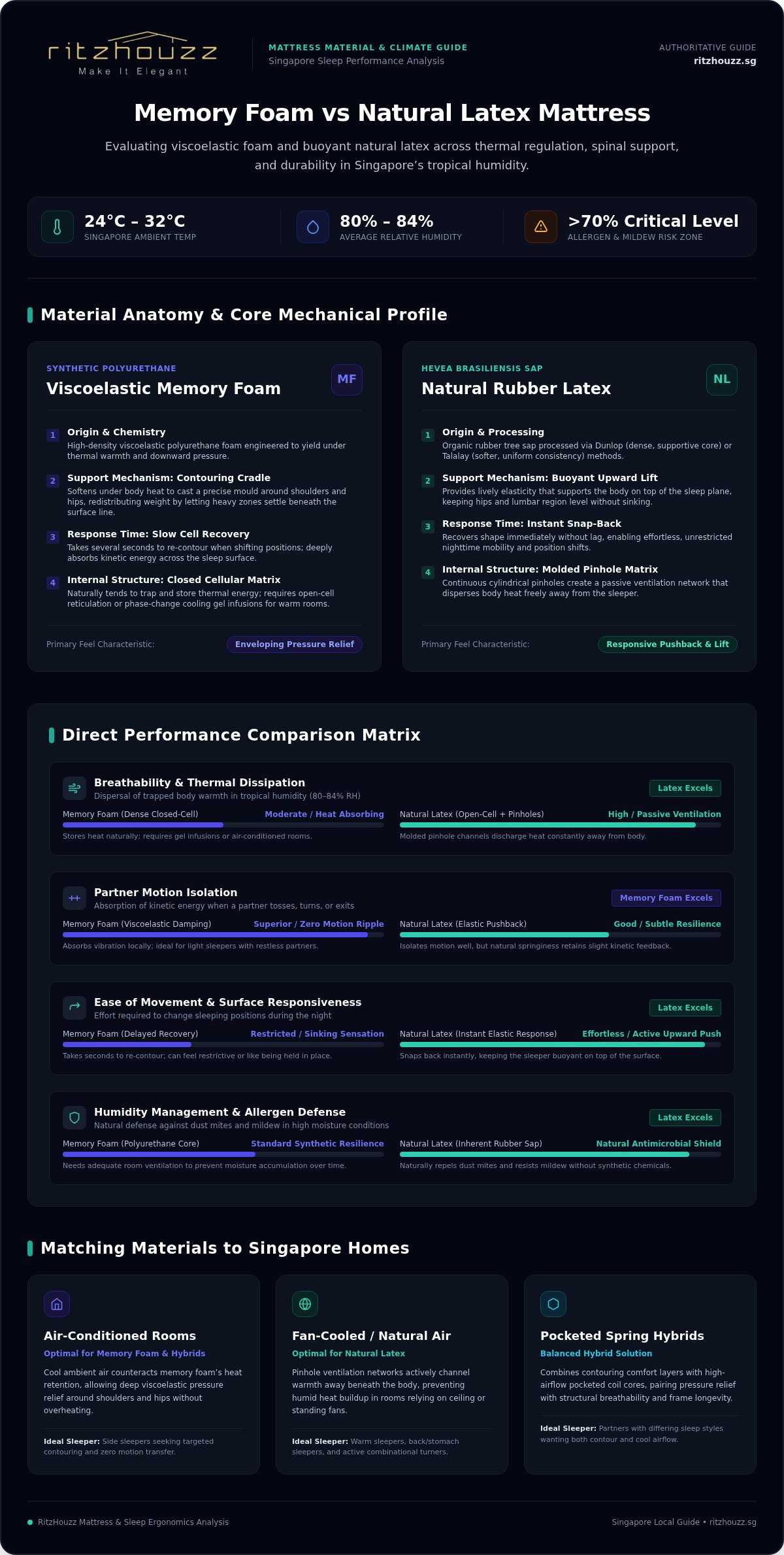
The distinction comes down to whether you prefer an enveloping cradle or buoyant elevation. Foam redistributes weight by letting heavier zones settle gently beneath the surface line. Latex supports the body on top of the sleep plane, maintaining an active upward push that preserves swift mobility. Here is how their physical properties differ:
- Conforming vs Buoyant: Viscoelastic cells soften under warmth to cast a precise mould of your frame. Latex provides instant lift, ensuring your hips and lumbar region remain level without deep sinking.
- Response Speed: Foam takes several seconds to re-contour when you turn. Latex snaps back instantly, allowing seamless shifts without feeling restricted.
- Weight Distribution: Dense foam disperses localized stress across a broad surface area. Latex absorbs load progressively, increasing resistance as more weight is applied.
Understanding Viscoelastic Memory Foam
Engineered from high-density viscoelastic polyurethane foam, this material softens in direct response to thermal energy and downward pressure. For side sleepers, it provides deep pressure relief around the shoulders and hips, preventing uncomfortable pressure peaks. Its slow cell recovery also absorbs kinetic energy across the bed. If your partner turns or gets up early, the motion stays localized rather than rippling across your side.
Understanding Natural and Synthetic Latex
Natural latex originates as organic milky sap harvested from Hevea brasiliensis rubber trees, whereas synthetic variants rely on petroleum-derived styrene-butadiene rubber (SBR). The sap is processed using either the Dunlop method, which yields a dense and supportive core, or the Talalay method, which creates a softer, more uniform consistency. Regardless of production style, latex delivers immediate resilience. This inherent elasticity prevents that trapped feeling, keeping movement effortless throughout the night.
Understanding these distinct physical profiles is the first step in weighing a memory foam vs latex mattress Singapore sleepers can rely on for balanced comfort.
Cooling and Breathability in Singapore's Tropical Humidity
Sleeping comfortably in our equator-bound climate requires exceptional thermal management. Factoring in Singapore's high ambient humidity and temperature, which consistently hovers between 24°C and 32°C alongside relative humidity exceeding 80%, a mattress core must either disperse body heat or actively channel it away. Without steady ventilation, trapped warmth turns an otherwise supportive bed into an uncomfortable sleep surface.
Your room setup plays a decisive role here. In air-conditioned master bedrooms, dense materials perform reasonably well because cooler ambient air helps balance surface warmth. In fan-cooled common rooms, however, heat dissipation becomes paramount. Evaluating a memory foam vs latex mattress Singapore homeowners quickly see that breathability directly determines whether you wake up refreshed or overheated.
Thermal Regulation: Pinhole Latex vs Gel Foams
Natural latex features an inherently open cellular matrix molded with cylindrical pinholes. These continuous channels create a passive ventilation network, allowing heat to escape freely beneath your body. Traditional viscoelastic polyurethane, by contrast, relies on a denser, closed-cell structure that tends to absorb and store thermal energy. Modern foam designs counteract this retention by infusing phase-change cooling gels and adopting reticulated open cells, though these formulations perform best when paired with specialized high-conductivity covers or pocketed spring foundations.
Humidity Management and Allergen Resistance
Ambient moisture poses challenges beyond mere temperature discomfort. Prolonged relative humidity above 70% creates an ideal breeding ground for microscopic allergens within soft furnishings. Protecting your sleep space requires materials that handle moisture without degrading:
- Natural Antimicrobial Defenses: Natural rubber latex naturally repels dust mites and resists mildew development without requiring added chemical finishes.
- Cell Resilience: Memory foam needs dedicated airflow to prevent moisture buildup within dense polyfoam cores. Using water-resistant, breathable mattress protectors shields the core from perspiration.
- Room Airflow: Keep bedroom windows open during breezy afternoons or run a dehumidifier periodically to prevent ambient dampness from settling deep into foam layers.
For those navigating the memory foam vs latex mattress Singapore selection, feeling how these materials regulate surface temperature firsthand makes all the difference. You can explore cooling mattress innovations at RitzHouzz to determine which material composition suits your room's airflow and cooling needs.
Spinal Support, Motion Isolation, and Longevity Compared
Proper musculoskeletal alignment depends on how well a core sustains weight distribution across your natural posture. A surface that sags forces the spine out of alignment, while an excessively hard board creates sharp pressure points. As noted in the Harvard Health guide to mattress firmness and back pain, medium-firm sleeping surfaces generally offer the best balance of comfort and postural support, preventing unnatural spinal curvature during sleep.
Light sleepers sharing a bed face another layer of complexity. Motion isolation determines whether your partner's restless movements wake you up. Memory foam excels here, absorbing kinetic vibration directly beneath the sleeper. Natural latex also dampens movement effectively, though its rubber resilience retains a faint, subtle bounce compared to dead-stop foam absorption.
Spinal Alignment and Pressure Distribution
Side sleepers require yielding relief beneath the shoulders and pelvic girdle to maintain a straight spine. High-density viscoelastic foam fills the lumbar recess smoothly, distributing contact stress across a broader surface area. Back and stomach sleepers, however, require firmer pushback to keep their hips from sinking too deeply. Natural latex excels at holding heavier torso weight elevated on an even plane, preventing the lower back from hyperextending into an unnatural hammocking position.
Durability and Sagging Resistance Over Time
Long-term structural resilience is a central factor when weighing a memory foam vs latex mattress Singapore homeowners plan to keep for years. Under daily mechanical loads and tropical humidity, materials age differently:
- Natural Latex Longevity: Vulcanised rubber latex from Hevea brasiliensis holds structural integrity for 10 to 15 years or more, resisting permanent body impressions as long as it stays shielded from direct sunlight.
- Memory Foam Lifespan: Quality high-density viscoelastic cores typically deliver 7 to 10 years of balanced service before repeated thermal softening causes permanent cell compression and softening.
- Perimeter Stability: All-foam slabs lack rigid side walls, meaning edges compress deeply when you sit up. Latex maintains firmer perimeter pushback, though both materials benefit substantially from reinforced border encasements.
Understanding these durability profiles clarifies the long-term value of each surface. In the ongoing comparison between a memory foam vs latex mattress Singapore sleepers can measure immediate pressure contouring against lasting physical resilience to pick the right foundation for their home.
How to Choose: Matching Materials to Your Sleeping Profile
Every sleeper brings distinct anatomical proportions, resting habits, and sensitivity thresholds to bed. Choosing correctly requires balancing your dominant resting posture with practical lifestyle factors rather than relying on one-size-fits-all recommendations. In the assessment of a memory foam vs latex mattress Singapore residents must weigh personal biomechanics against daily household routines.
Start by identifying your baseline physical priorities across three core areas:
- Pressure Point Sensitivity: If your shoulders or hip bones ache on conventional beds, the deep conforming cradling of viscoelastic foam reduces localized stress peaks.
- Mobility and Spinal Stability: If you prefer rolling over effortlessly or sleep predominantly on your back, the resilient lift of natural latex prevents excessive pelvic dip.
- Partner Movement Dynamics: For those sharing a bed with a restless partner or someone working irregular hours, high-density foam dampens motion transfer with pinpoint precision.
Matching Your Sleep Position and Body Profile
Strict side sleepers benefit from viscoelastic foam because it yields directly beneath angular joints, keeping the neck and thoracic spine parallel to the bed. Back and stomach sleepers fare far better on resilient latex. Its active resistance supports the lumbar curve without allowing the abdominal area to drop forward, preserving neutral posture. Combination sleepers who shift positions three or four times an hour will appreciate the instant snap-back of latex, which avoids that temporary groove that can impede movement.
Practical Household and Room Environment Factors
Daily domestic routines also influence which core works best in your living space. Natural rubber latex carries 25% to 30% more physical mass than standard polyurethane foams. That extra weight requires noticeable effort when lifting corners during weekly sheet changes, and it demands sturdy support underneath. If you use a hydraulic storage bed or integrated bedroom carpentry, verify that the lifting pistons can handle a dense latex slab without strain.
Nighttime cooling habits matter just as much. Homes relying primarily on ceiling fans rather than continuous overnight air-conditioning benefit from the natural breathability of pinhole latex or open-coil hybrid systems. If you run your air-conditioner at 24°C throughout the night, gel-infused memory foam remains pleasantly temperature-neutral.
If you need personalized advice on balancing material density with your bedroom layout, connect with our sleep specialists at RitzHouzz to discuss tailored mattress options and bed frame configurations.
Showroom Testing and Hybrid Alternatives for Singapore Homes
Pure material slabs are not your only choice. Many homeowners find that their decision in the memory foam vs latex mattress Singapore comparison leads directly to hybrid engineering. By pairing a pocketed spring base with specialised top comfort layers, hybrids deliver targeted pressure relief while maintaining steady internal ventilation that solid foam cores simply cannot match.
The empty chambers between individual barrel-shaped coils act as natural air corridors. Every time you shift during sleep, the bellows effect circulates ambient air through the mattress core, venting residual humidity. This design balances conforming comfort with thermal regulation, making it a compelling configuration for local master bedrooms.
The Hybrid Advantage: Springs with Foam or Latex
A pocketed spring foundation isolates each coil within its own fabric sleeve, compressing only where weight is applied. When crowned with cooling foam or responsive latex, you gain contoured support without feeling trapped. Premium sleep systems like the Snow snooze mattress illustrate this balance, uniting pressure-relieving comfort layers with independent spring support to keep warm air moving freely throughout the night.
For even greater temperature management, specialized collections incorporate high-thermal-conductivity fabric tickings. In advanced hybrid models, specialized yarn fibers draw excess heat away from the skin upon contact. You can explore these configurations within our curated sleep system collection to match comfort materials with high-performance cooling fabrics.
Conducting a Thorough Showroom Comfort Test
Online specifications provide valuable context, but your body offers the definitive test. A brief two-minute sit on the edge of a bed will never reveal how your lower back rests after four hours of sleep. To evaluate a bed properly, adopt a structured assessment routine:
- Rest for Fifteen Minutes: Lie down in your habitual sleep position for at least 10 to 15 minutes, allowing your body weight and warmth to settle into the comfort layers.
- Verify Spinal Neutrality: Have your partner or a specialist check that your neck and spine remain parallel to the sleep plane without excessive dipping around the hips.
- Test Changing Positions: Roll from your back to your side to evaluate surface responsiveness and check whether movement disturbs your partner.
- Examine Perimeter Strength: Sit along the edge to ensure reinforced borders support you securely when getting in and out of bed.
Experiencing these materials in person eliminates guesswork and ensures total confidence in your choice. When evaluating a memory foam vs latex mattress Singapore homeowners can discover their ideal comfort profile firsthand by planning a visit to our showroom for personalized testing at RitzHouzz.
Find Your Ideal Sleep Surface with Confidence
Selecting the right mattress comes down to how your body interacts with support and airflow. In the comparison of a memory foam vs latex mattress Singapore bedrooms demand materials that harmonize with personal posture and tropical humidity alike. Whether you favor the cradling pressure relief of viscoelastic foam, the buoyant breathability of vulcanised latex, or the ventilated responsiveness of a pocketed spring hybrid, true restorative rest begins with what feels natural to you.
Reading specifications provides clarity, but feeling the layers under resting weight brings complete certainty. As an authorized retailer of Lady Americana sleep systems, RitzHouzz welcomes you to explore extensive showroom displays featuring advanced cooling hybrid technologies. Our dedicated sleep specialists offer practical, unbiased guidance tailored to your home layout and resting habits. Book a personalized mattress consultation at RitzHouzz today, and wake up refreshed every morning.
Frequently Asked Questions
Is latex or memory foam better for hot sleepers in Singapore?
Natural latex is noticeably better for hot sleepers due to its open-cell structure and molded ventilation pinholes. Ambient humidity in Singapore frequently exceeds 80%, causing dense viscoelastic foams to trap body warmth unless paired with cooling fabrics or pocketed coils. Latex naturally circulates air, keeping the sleep surface cooler through the night even in fan-cooled rooms. In the debate between a memory foam vs latex mattress Singapore warm sleepers generally find latex significantly more breathable.
How long does a natural latex mattress last compared to memory foam?
A high-quality natural latex mattress typically lasts between 10 and 15 years, whereas high-density memory foam averages 7 to 10 years. Vulcanised rubber harvested from rubber trees maintains structural resilience and elasticity over extended periods without developing permanent sags. Viscoelastic foam gradually softens through recurring body warmth and downward pressure, eventually leading to permanent body impressions that diminish ergonomic spinal support over time.
Can memory foam cause back aches if used without air conditioning?
Memory foam softens under higher ambient heat, which can lead to reduced spinal support in rooms without air conditioning. Viscoelastic polyurethane responds to ambient room temperature as well as body heat. In a warm, unconditioned room hovering around 30°C, the foam softens faster and compresses deeper beneath heavier areas like the hips. This excessive sinking can pull your lumbar spine out of neutral alignment, leading to waking stiffness.
Is motion isolation better on a memory foam or latex mattress?
Memory foam offers superior motion isolation compared to natural latex. The viscous cell structure of polyurethane foam absorbs kinetic energy directly at the contact point, stopping movement from rippling across the surface. While latex absorbs motion far better than traditional open innersprings, its natural rubber elasticity retains a subtle bounce. For exceptionally light sleepers sharing a bed with an active partner, memory foam deadens disturbance best.
Are latex mattresses naturally resistant to dust mites and mold?
Yes, authentic natural latex is inherently resistant to dust mites, mildew, and fungal growth. The organic composition of vulcanised rubber creates a hostile environment for microscopic organisms without requiring chemical antimicrobial treatments. In Singapore's humid climate, where ambient moisture often encourages allergen buildup inside soft bedding, natural latex provides a naturally hygienic foundation. Regular room ventilation and a quality protector ensure its long-term cleanliness.
Can you get a hybrid mattress that combines latex, foam, and springs?
Yes, many modern hybrid sleep systems blend pocketed coils with comfort layers of latex or memory foam. Hybrid designs solve the primary trade-offs of solid foam beds by combining coil airflow with tailored pressure relief. Collections like the Snow snooze mattress and Lady Americana models pair independent pocketed springs with specialized cooling comfort layers, delivering targeted contouring, low motion transfer, and uninterrupted thermal regulation.
What should I look for when testing a mattress in a Singapore showroom?
Focus on your dominant sleep posture, spinal alignment, and edge support while resting for at least fifteen minutes. When evaluating a memory foam vs latex mattress Singapore showroom visitors should lie down in their habitual sleeping position. Check whether your spine remains level without your hips sinking too deep. Shift positions to evaluate surface response speed, and test the bed with your partner to confirm comfortable motion isolation and stable perimeter support.
Disclaimer
The information in this article is provided for general guidance only and is intended to help readers make informed decisions about mattresses, furniture, renovation, carpentry and related home solutions. Product specifications, prices, promotions, availability, warranties and services may change without notice. Actual colours, materials, dimensions and comfort may vary from images or descriptions. For renovation, carpentry or space-planning projects, final recommendations, measurements, scope of work and quotations should be confirmed directly with RitzHouzz before proceeding. Mattress comfort and suitability are subjective, and any health-related information is general in nature and should not be treated as medical advice. Please contact RitzHouzz or visit our showroom for the latest product and service information.