

Marble vs Quartz Dining Table Comparison: Which Surface Suits Your Home?
The most coveted, heirloom-grade tabletop in luxury design might actually prove to be your greatest source of daily household anxiety. In any marble vs quartz dining table comparison, the tension between timeless organic artistry and practical resilience surfaces immediately. You likely adore the romantic, one-of-a-kind veining of natural stone, yet the constant worry of acidic spills, wine rings, or hot serving dishes etching the surface can turn relaxed family meals into an exercise in caution.
It's completely understandable to want a striking centerpiece without sacrificing peace of mind. We'll examine the critical differences in porosity, scratch resistance, heat tolerance, and long-term maintenance demands between natural marble and engineered quartz slabs. Ahead, you'll explore a practical framework that matches each tabletop material directly to your household habits, helping you choose the ideal surface for your dining space with lasting confidence.
Key Takeaways
- Understand the structural differences between organic metamorphic rock and resin-bound composite slabs to predict how each surface behaves under daily dining demands.
- Review an evidence-based marble vs quartz dining table comparison covering surface hardness, liquid porosity, scratch susceptibility, and heat tolerance.
- Uncover realistic long-term care expectations, balancing the disciplined sealing routine of natural stone against the effortless upkeep of non-porous quartz.
- Identify which tabletop finish and silhouette best complements your specific household rhythm, whether hosting formal dinners or managing busy family meals.
- Gain clear guidance on selecting cohesive dining table sets with matching chairs proportioned seamlessly for contemporary apartment and residential layouts.
Understanding the Core Differences: Natural Marble vs Engineered Quartz
Every considered interior begins with material integrity. When evaluating a marble vs quartz dining table comparison, the initial distinction rests in how each surface comes into existence. Natural marble is a metamorphic rock formed over millennia under intense subterranean heat and pressure, recrystallizing limestone into dense calcite or dolomite stone. In contrast, modern dining tabletops frequently feature engineered quartz, a sophisticated composite surface produced by binding approximately 90% crushed natural quartz crystals with high-performance polymer resins and carefully selected mineral pigments.
This fundamental distinction between organic formation and intentional manufacturing shapes how each tabletop looks and lives in your dining space:
- Natural Marble: Yields entirely bespoke slab characteristics where mineral deposits form one-of-a-kind veining patterns, ensuring no two tabletops are ever identical.
- Engineered Quartz: Delivers controlled aesthetic precision, offering uniform grain patterns, predictable tones, and consistent visual balance across wide dining surfaces.
The Geology and Aesthetic Character of Natural Marble
Authentic marble tells an ancient geological story. Iron oxides, clay, silt, and serpentine deposits settle between limestone strata during metamorphic formation, creating spontaneous veining that branches across the stone. These tonal variations and textural shifts aren't defects; they're the hallmarks of authentic geological character. Run your hand across a polished or honed marble slab, and you immediately register its signature cool-to-touch sensation and soft, light-diffusing lustre that synthetic materials struggle to emulate.
The Composition and Engineering of Quartz Surfaces
Modern quartz surfaces unite structural resilience with intentional artistry. By blending dense mineral quartz aggregates with resilient binders, manufacturers achieve refined aesthetic designs that capture the movement of natural stone without its organic unpredictability. Crucially, the curing process fuses the composite under vacuum and high vibration, creating a virtually non-porous structure with an exceptionally low water absorption rate of roughly 0.02%. This engineered density transforms day-to-day dining, giving homeowners a resilient surface that repels liquids effortlessly without periodic stone sealers.
Selecting between these two distinctive materials sets the tone for your dining room. A thorough marble vs quartz dining table comparison reveals that the real choice lies between embracing the irreplaceable, living beauty of natural stone or enjoying the uniform elegance and relaxed confidence of engineered design.
Marble vs Quartz Dining Table Comparison: Performance and Durability
Selecting the right dining tabletop requires looking past pristine showroom lighting and evaluating how materials withstand daily domestic rituals. In any comprehensive marble vs quartz dining table comparison, physical durability centers on four key criteria: porosity, scratch resistance, chemical sensitivity, and thermal limits. While both stones anchor high-end dining spaces, their molecular structures behave very differently when encountering cutlery, citrus juices, or hot serving dishes.
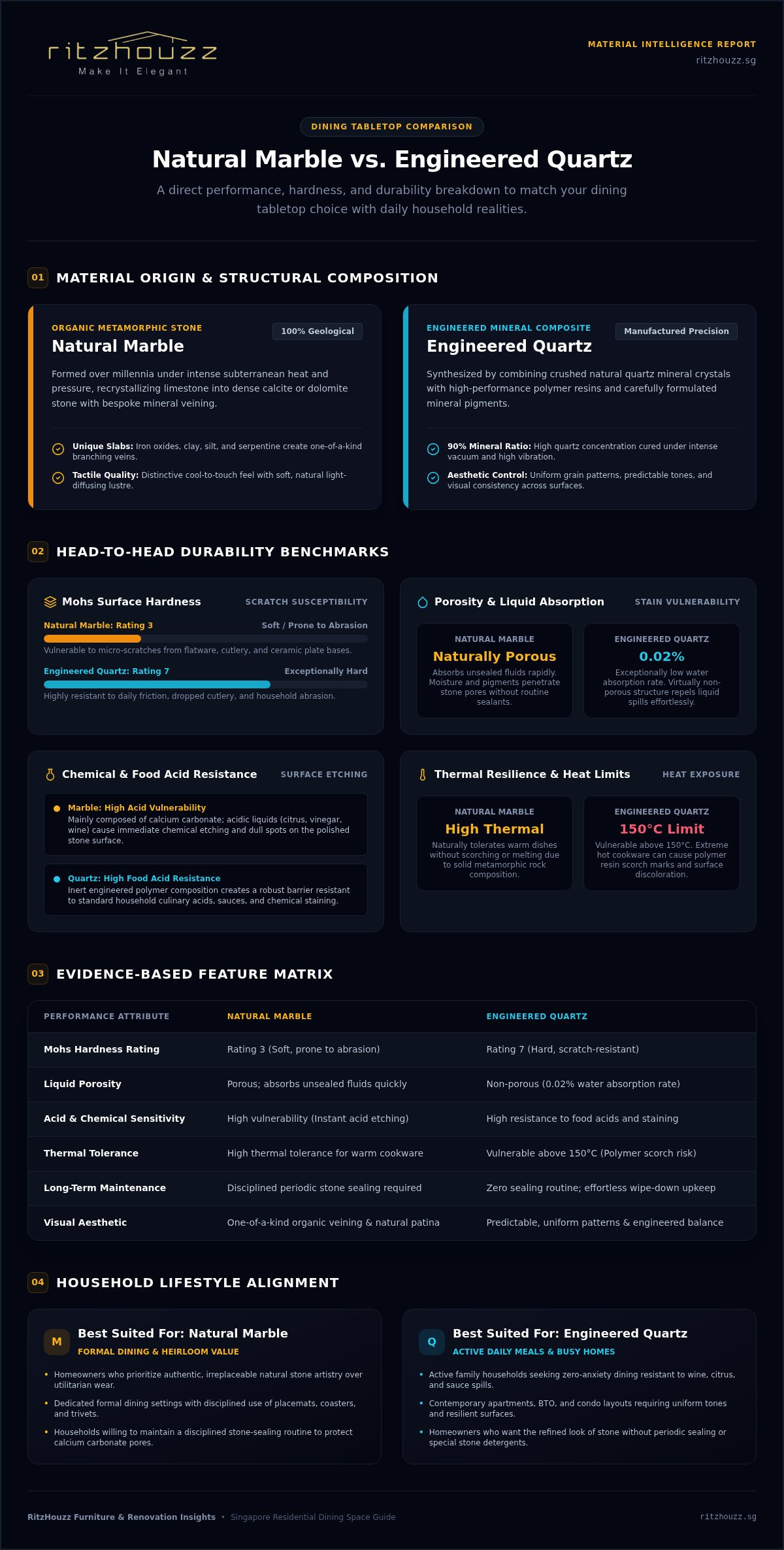
| Performance Attribute | Natural Marble | Engineered Quartz |
|---|---|---|
| Mohs Hardness | Rating: 3 (Soft, prone to abrasion) | Rating: 7 (Exceptionally hard and scratch-resistant) |
| Porosity & Absorption | Porous; absorbs unsealed fluids quickly | Non-porous (0.02% water absorption rate) |
| Chemical & Acid Vulnerability | High; acids cause instant chemical etching | High resistance to common food acids and staining |
| Heat Resilience | High thermal tolerance; withstands warm dishes | Vulnerable above 150°C; risk of polymer resin scorch |
For homeowners exploring curated arrangements, our connoisseur's perspective on luxury dining tables sheds light on how intentional tabletop choices elevate the dining room environment.
Porosity, Staining, and Resistance to Food Acids
Natural marble is primarily composed of calcium carbonate, making it chemically reactive to acids. Spills from red wine, dark soy sauce, coffee, or sliced lemons dissolve the surface polish, leaving dull etches and deep discoloration. High-grade engineered quartz eliminates this anxiety. Because its dense composition leaves no microscopic fissures for liquids to penetrate, stubborn sauces wipe clean without leaving indelible shadows.
Scratch Resistance, Chipping, and Structural Rigidity
Daily activity leaves telltale marks on softer surfaces. With a modest rating of 3 on the Mohs hardness scale, marble yields easily to ceramic dish bases, dragged silverware, and metallic decor. Quartz registers at 7, offering robust resilience against inadvertent scrapes. Even so, table perimeters remain vulnerable to blunt impacts; chamfered or rounded edge profiles help prevent chipping across both materials.
Thermal Tolerance and Handling Warm Serving Dishes
Thermal behavior reveals marble's distinct physical advantage. Formed through intense geological heat, authentic stone tolerates warm teapots and serving platters without melting or discoloring. Quartz, however, incorporates polymer resins that cannot withstand sustained direct temperatures exceeding 150°C. Sudden contact with boiling pots triggers thermal shock, causing resin yellowing or hairline cracks. As documented by the Natural Stone Institute, using trivets and padded runners remains essential practice for preserving any stone surface indefinitely.
If you're weighing which tabletop construction best supports your family's daily routine, feel free to consult our design specialists for tailored material recommendations.
Everyday Maintenance and Long-Term Care Realities
Surface longevity depends entirely on what happens after the meal concludes. In this practical marble vs quartz dining table comparison, everyday care highlights the starkest contrast between natural stewardship and engineered convenience. Marble demands intentional habits and disciplined upkeep. Conversely, engineered quartz delivers effortless simplicity, needing no specialized treatments to retain its lustrous finish year after year.
Understanding these practical maintenance demands ensures your investment continues to elevate your dining room rather than creating an unwelcome chore:
- Daily Sanitisation: Quartz cleans up instantly with warm water and mild dish soap, while marble requires gentle, pH-neutral cleaners to avoid dulling its surface.
- Penetrating Sealants: Marble relies on routine sealing every 6 to 12 months to stave off deep-set liquid discoloration; quartz never requires sealing during its lifespan.
- Aesthetic Evolution: While quartz maintains a uniform, factory-fresh finish, natural marble gradually acquires a soft living patina that reflects years of hospitality.
Daily Cleaning Routines and Approved Cleaning Solutions
Post-dinner wiping requires strict attention to chemical balance. Because the geological formation of marble leaves its calcite base vulnerable to chemical breakdown, common household degreasers, bleach, and citrus-scented sprays will quickly strip its seal. Homeowners must use a soft microfibre cloth dampened with warm water or dedicated stone soaps. Quartz, by comparison, remains impervious to everyday sanitising sprays, effortlessly resisting grease smears without delicate handling.
Preventative Sealing and Restoring Surface Sheen
Guarding marble against dark liquids requires periodic intervention. Applying a quality penetrating impregnator every 6 to 12 months fills microscopic pores, providing valuable reaction time when a spill happens. To verify protection, drop a small bead of tap water onto the tabletop. If the droplet flattens and darkens the stone within ten minutes, the surface needs resealing. If etching or fine scratches do develop over time, professional stonemasons can hone and repolish the slab in place, fully restoring its soft natural glow.
Ultimately, this phase of our marble vs quartz dining table comparison comes down to temperament. Choosing marble means embracing the tactile character and gentle aging of authentic stone. Selecting quartz prioritises worry-free utility, letting you host vibrant family dinners without reaching for specialized cleaning kits the moment a glass tips over.
Lifestyle and Design Alignment: Selecting the Best Tabletop for Your Home
A successful interior balances tactile beauty with the realities of your daily routine. When you translate a marble vs quartz dining table comparison into your private living space, the right choice depends on your household dynamics and architectural layout. A finish that thrives in an executive penthouse might introduce daily friction into an active family home, making lifestyle alignment the ultimate deciding factor.
Consider how these domestic variables influence your decision:
- Active Family Life: Spilled fruit juices, homework marker pens, and dropped cutlery demand the forgiving, non-porous resilience of quartz.
- Refined Entertaining: Intimate dinner parties and multi-course tastings allow natural marble to shine as an authentic conversation piece.
- Atmospheric Lighting: Strong ambient daylight flatters soft honed textures, while gentle evening illumination accentuates high-gloss polished stone.
Matching Surface Durability to Your Family Dining Habits
Young children transform dining tables into bustling activity hubs. If your dining area hosts after-school crafts, casual weekday breakfasts, and lively communal dinners, engineered quartz provides complete peace of mind. It shrugs off accidental ink marks and spilled condiments effortlessly. Conversely, if your home revolves around curated evening hosting where guests treat surfaces with care, authentic marble offers unmatched romance, turning natural patina into a badge of domestic history.
Harmonising Table Finishes with Interior Lighting and Chairs
Stone should never exist in isolation. In rooms with expansive floor-to-ceiling windows, high-gloss marble can occasionally cast harsh glares; choosing a matte, honed quartz or softly finished stone diffuses natural light gracefully. Balance the visual weight of stone by pairing your table with upholstered or supple leather dining chairs. Incorporating warm textiles softens the stone's inherent coolness, while a pedestal table base preserves generous legroom and unhindered movement within compact floor plans.
Exploring Coordinated Living and Dining Furnishings
Open-concept Singapore residences require thoughtful cohesion across adjacent zones. Unifying your dining tabletop with nearby seating establishes effortless visual rhythm throughout the hall. Homeowners frequently balance a statement stone dining table by introducing textural depth in the living room through our curated sofas, echoing neutral undertones across fabric or leather finishes.
To tailor your dining set dimensions and material profiles perfectly to your home layout, get in touch with our design specialists via the RitzHouzz Contact portal for personalised layout advice.
Designing Your Custom Dining Space with RitzHouzz
Selecting an exceptional tabletop is only the first step in creating an inviting dining room. At RitzHouzz, our dedicated interior space planning and bespoke furniture services ensure your chosen surface integrates seamlessly into your residential floor plan. Rather than navigating standard retail catalogues alone, you benefit from practical design consultancy that pairs material durability with balanced spatial dimensions.
Our collaborative design consultation walks you methodically through every spatial consideration:
- Proportion and Spatial Flow: Calculating essential walkway clearances so family members and guests move comfortably around the dining setting.
- Silhouette Selection: Evaluating rectangular, oval, or round configurations tailored to open-concept living-dining layouts.
- Cohesive Seating Ensembles: Pairing tabletop stone profiles with complementary dining chairs for unified height, texture, and ergonomic support.
Tailored Space Planning and Table Proportion Selection
Proportions dictate dining comfort. Homeowners should maintain at least 90 centimetres of clearance between the table perimeter and surrounding walls or cabinetry, allowing dining chairs to pull back smoothly without obstructing adjoining hallways. In long, linear dining zones, rectangular tables provide structured formality. In square rooms or open layouts, sculptural round tables foster fluid movement and intimate conversation while softening room geometry.
Selecting Coordinating Dining Chairs and Custom Finishes
Ergonomics turn a beautiful table into a welcoming gathering space. Standard stone tabletops typically sit 75 centimetres high, requiring dining chairs with a seat height of approximately 45 centimetres to ensure ample legroom beneath the apron. Whether you choose natural marble or engineered quartz, pairing the tabletop with wipe-clean leather or rich fabric upholstery creates tactile warmth. Subtle neutral fabrics let the stone veining take center stage without visual competition.
A rigorous marble vs quartz dining table comparison clarifies which surface fits your lifestyle, but seeing how materials and dimensions interact within your exact room layout brings complete certainty. To tailor your dining table dimensions, material selections, and chair pairings, connect with our specialists via RitzHouzz Contact to review your floor plans and commission your ideal dining setting.
Select the Perfect Centerpiece for Your Dining Space
Resolving your marble vs quartz dining table comparison ultimately hinges on honoring your domestic rhythm. Natural marble offers incomparable organic character, celebrating the subtle patina of hospitality for homeowners who welcome mindful stone care. Engineered quartz delivers pristine, non-porous resilience, providing relaxed confidence against spills, scuffs, and vibrant family gatherings.
Your tabletop should do more than simply fit into a room; it should anchor daily life effortlessly. Through our bespoke furniture customisation and space planning expertise, RitzHouzz helps you identify the ideal silhouette, stone finish, and complementary dining chairs for your home layout. We guide you past guesswork, ensuring balanced walkways and enduring craftsmanship across every detail. Connect with our furniture consultants at RitzHouzz to select your ideal dining table set and create a welcoming dining room you'll cherish for decades to come.
Frequently Asked Questions
Can hot pots and pans be placed directly onto a quartz dining table?
No, you should never place cookware taken straight from the stove or oven onto a quartz surface. The engineered composite contains polymer resins that can scorch, yellow, or crack when subjected to temperatures above 150°C. Sudden thermal shock can permanently damage the surface. Always place warm serving platters, soup tureens, and hot teapots onto insulated trivets or protective runners to keep the slab pristine.
How frequently does a natural marble dining table require resealing?
Natural marble dining surfaces typically require resealing every 6 to 12 months. Maintenance frequency depends on daily usage and cleaning habits. A simple water droplet test indicates when protection fades; if a droplet absorbs and darkens the stone within ten minutes, apply a fresh penetrating sealer. In any marble vs quartz dining table comparison, factoring in this ongoing care helps determine whether natural stone fits your lifestyle.
Are marble dining tables prone to permanent stains from red wine and coffee?
Yes, untreated or unsealed marble readily absorbs dark liquids such as coffee, tea, and red wine. Because calcium carbonate is inherently porous, pigment seeps into microscopic channels if spills sit unaddressed. Even when sealed, acidic substances like citrus juices, vinegar, and tomato sauces react chemically with the stone, creating dull etched rings. Promptly blotting spills with a damp cloth prevents permanent discoloration.
Which tabletop surface is more scratch-resistant for daily dining?
Engineered quartz provides significantly higher scratch resistance than natural marble. Quartz rates at 7 on the Mohs hardness scale, easily withstanding sliding dishware, cutlery, and metallic decorative objects. In contrast, softer marble rates around 3, leaving it vulnerable to fine scratches and dull abraded areas. Households seeking a carefree tabletop for busy daily meals will find quartz noticeably more forgiving.
Does engineered quartz look identical to genuine natural marble?
High-grade engineered quartz convincingly mimics natural stone veining, though subtle differences remain apparent upon close inspection. Quartz patterns offer deliberate symmetry, consistent coloration, and predictable aesthetics across the entire slab. Natural marble, however, possesses organic geological depth, subtle translucency, and an authentic cool-to-the-touch tactile feel. While quartz provides uniform beauty, authentic marble guarantees that no other home has a tabletop identical to yours.
What is the best way to clean and sanitise a marble dining table daily?
Clean your marble table daily using a soft microfibre cloth dampened with warm water and gentle, pH-neutral stone soap. You should strictly avoid generic kitchen degreasers, vinegar solutions, lemon cleaners, and abrasive scouring pads. These acidic or harsh chemicals quickly dissolve the sealer and etch the soft calcite crystal structure. Always dry the tabletop with a separate clean cloth to avoid residual water marks.
Can an etched or stained marble dining table be restored to its original finish?
Yes, professional stonemasons can successfully restore deeply stained or etched marble tabletops. Trapped organic oils and wine stains often lift out using specialized poultice pastes. For surface etching and fine cutlery scratches, technicians hone away a microscopic layer before repolishing the stone. While engineered quartz requires less daily vigilance in a marble vs quartz dining table comparison, authentic marble offers the rare benefit of renewal over generations.
How do I determine the right dining table dimensions for my home layout?
Determine suitable dimensions by leaving a minimum of 90 centimetres of open clearance between the table perimeter and surrounding walls or cabinetry. This dedicated walkway lets diners pull chairs back comfortably and pass by without disruption. In open-concept or square floor plans, round tables preserve walkway circulation, whereas rectangular tables complement long dining zones. Evaluating your room dimensions ensures comfortable movement around the table.
Disclaimer
The information in this article is provided for general guidance only and is intended to help readers make informed decisions about mattresses, furniture, renovation, carpentry and related home solutions. Product specifications, prices, promotions, availability, warranties and services may change without notice. Actual colours, materials, dimensions and comfort may vary from images or descriptions. For renovation, carpentry or space-planning projects, final recommendations, measurements, scope of work and quotations should be confirmed directly with RitzHouzz before proceeding. Mattress comfort and suitability are subjective, and any health-related information is general in nature and should not be treated as medical advice. Please contact RitzHouzz or visit our showroom for the latest product and service information.