

How to Agree on Furniture Style With a Partner: A Practical Guide
Choosing furniture together can be easier if you stop comparing individual pieces for a moment. When partners have different tastes, a sofa or dining table can quickly become a debate about whose style belongs at home. To learn how to agree on furniture style with a partner, start by discussing how you want the room to feel, then identify the practical needs you share. A conversation about comfort, atmosphere and daily routines gives you common ground before you browse.
This matters in Singapore, where an HDB flat or condo may require each piece to work hard in a compact layout. You don’t need identical tastes to create a cohesive home. You need shared priorities and a fair way to make decisions. This guide explains how to set those priorities, discuss budget and function, and combine different preferences without leaving one person feeling overlooked. You’ll also learn to assess furniture as part of the whole room, so individual choices contribute to a considered, comfortable space that feels like yours together.
Key Takeaways
- Different tastes don’t mean one partner has to give up their preferences. Start by discussing how you want the room to feel.
- To work out how to agree on furniture style with a partner, compare your routines, practical needs and descriptive words for the space.
- Use a shared brief to assess shortlisted furniture for function, scale, visual fit and comfort for both partners.
- Measure relevant areas in your HDB, BTO, resale flat or condo before deciding whether a piece suits the room.
- Test your shared approach with one room or major purchase before applying it across the home.
Why Agreeing on Furniture Style With a Partner Can Feel Difficult
Different tastes don’t mean one partner has to surrender their preferences. A home can bring contrasting ideas together through shared priorities, rather than making one person’s style the winner. First, understand what sits behind each preference before discussing what to buy.
A furniture decision may seem to be about colour, shape or whether a sofa feels too formal. But one partner may be thinking about relaxing after work, while the other wants a room that feels open and welcoming when friends visit. A favourite dining table might bring back memories of family meals; a preference for a simpler interior might reflect a desire for fewer visual distractions. Those are different needs, not proof that one person has better taste.
The principles of interior design offer a useful way to think beyond individual objects: furniture shapes how a room functions and feels as a whole. For couples working out how to agree on furniture style with a partner, this shifts the question from “Which piece is nicer?” to “What should this room make possible for both of us?”
What furniture choices can represent to each partner
Before negotiating, each person can name the memory, routine or value connected to a favourite piece. Keep the explanation personal: “I like having a generous seat because we spend evenings together here” invites understanding; “This style is obviously better” invites a contest. Try asking:
- What would you like to do comfortably in this room?
- What feeling do you want when you walk in?
- Is there a piece or detail that matters to you, and why?
Listen for the need beneath the visual preference. A particular look may be tied to comfort, familiarity, easier hosting or a sense of belonging. Naming that need gives you both something practical to work with.
Why a forced middle ground can disappoint both people
Choosing a piece neither partner likes just to end the discussion can leave the room feeling like a compromise in the least satisfying sense. One person may feel unheard, while the other may have agreed to an item that doesn’t suit daily life. Agreement doesn’t require identical taste. It can come from finding shared priorities, then choosing furniture that supports them.
Stay curious before negotiating. If one partner prefers a striking sofa and the other wants a calm, uncluttered room, explore what matters most about each preference: visual character, seating comfort or how the piece fits the room. A different sofa shape, a more restrained colour or a considered mix of furnishings might address both concerns. The right choice depends on your shared needs, not on a rule that each person must give up the same amount.
Start by identifying the real disagreement. Is it about appearance, or about comfort, use and feeling at home? Once you know, you can identify what the room needs to support, record the visual qualities you both value and assess options together instead of deciding whose taste wins.
How to Build a Shared Furniture Style Brief Before You Shop
A short written brief gives both partners the same reference point once browsing begins. It doesn’t need to settle every preference. Its purpose is to clarify what the room must do, how you want it to feel and which practical limits a furniture choice needs to respect. Work through it together before saving products or visiting a showroom.
Start with how you want the room to work and feel
Discuss daily life before naming furniture styles. Take turns answering the questions below, then note where your answers overlap. This keeps the conversation grounded in your routines instead of competing pictures of an ideal home.
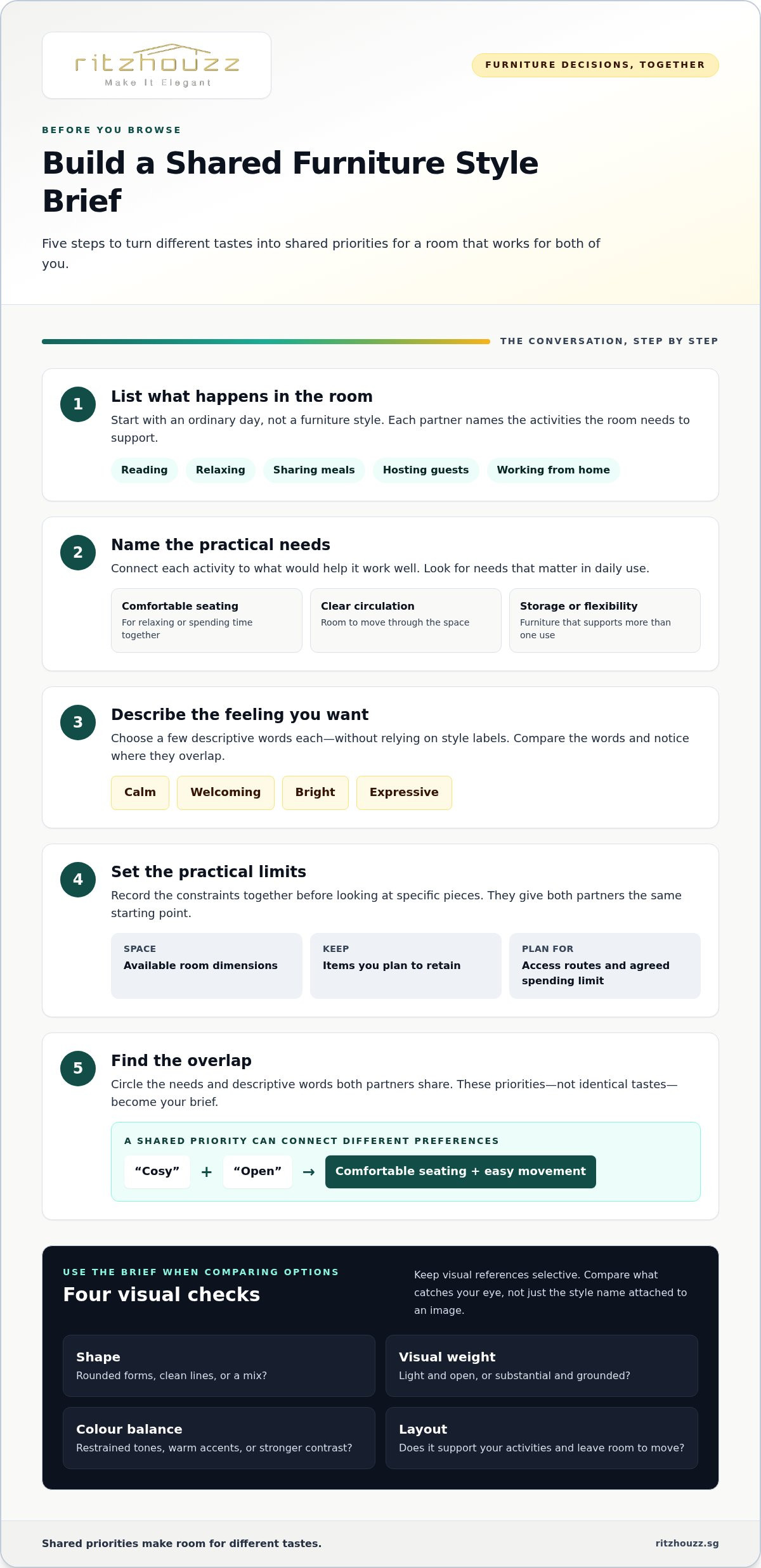
- List the room’s activities. Note what happens there on an ordinary day, such as reading, relaxing, sharing meals, hosting guests or working from home.
- Name the needs. Decide what those activities call for: comfortable seating, clear circulation, storage or furniture that supports more than one use.
- Describe the feeling. Each partner chooses a few words for the room without using style labels. Think “calm,” “welcoming,” “bright” or “expressive.”
- Set practical limits. Record the available space, items you plan to keep, access routes and any agreed spending limit before looking at specific pieces.
- Find the overlap. Circle needs and descriptive words that appear in both partners’ answers. These are your shared priorities, even if your preferred looks differ.
For example, one person might want a living room to feel “cosy” and the other “open.” Those preferences can coexist if both partners value comfortable seating and easy movement through the room. The brief should capture that shared requirement, rather than dictate a particular sofa or layout too soon.
Translate shared words into a simple visual brief
Turn the overlapping words into details you can assess. Keep your visual references selective: a small collection that clarifies shared preferences is more useful than an endless scroll. In each image, compare what catches your eye, not just the style name attached to it.
- Shape: Do you both respond to rounded forms, clean lines or a mix?
- Visual weight: Does the furniture look light and open, or substantial and grounded?
- Colour balance: Are you drawn to restrained tones, warm accents or stronger contrast?
- Layout: Does the arrangement leave room to move and support the activities you listed?
Write the brief in three parts: must-haves for essential needs, flexible choices where either partner is open to alternatives, and personal preferences that matter to one person but aren’t shared requirements. For example, comfortable seating might be essential, while a particular sofa colour remains flexible.
Save the brief somewhere both of you can revisit it. Add unresolved questions instead of forcing a decision. Once the brief is clear, you’ll have a practical way to learn how to agree on furniture style with a partner and judge options against shared criteria. If you’d like help turning your priorities into a room plan, contact RitzHouzz about your furniture plans.
How to Compare Furniture Choices Without Making One Style the Winner
Once you have a shared brief, assess each shortlisted piece against the same criteria. This keeps the conversation focused on how furniture will work in the room, rather than on which partner’s reference image it resembles. A simple comparison makes preferences visible while leaving room for practical judgement.
Use shared priorities as the decision criteria
For each option, ask whether it supports the room’s main activities, suits the available space, works visually with the rest of the room and feels comfortable to both partners. Mark each criterion as a strong fit, a possible compromise or a concern. The aim isn’t to produce a perfect score. It’s to make trade-offs clear enough to discuss fairly.
Option: A sofa under consideration
Shared brief: Comfortable everyday seating; keep the room easy to move through
Partner A: Likes its visual character; wants it to feel welcoming
Partner B: Prefers a less dominant look; values flexibility in the layout
Practical fit: Compare its scale with the room, check how it affects circulation, and consider whether both partners find it comfortable
Use a fresh set of notes for each shortlisted piece. Be specific about compromises: a visually distinctive item may have more presence in the room, while a more understated choice may be easier to coordinate with other furnishings. Neither trade-off is automatically right or wrong. For a living-room anchor such as a sofa, compare sofa styles against your shared requirements without assuming one shape or look suits every household.
Make room for personal expression within a cohesive room
Not every decision needs to be shared to the same degree. Agree together on the larger pieces that shape the room’s function and visual direction, then identify smaller details where individual taste can show. One partner might favour a minimalist accent, while the other chooses playful décor from Cozy Fox Lifestyle to bring charm and personality to the space. Both can belong if they fit the room’s shared priorities.
Look for a common thread between pieces. Repeating a colour, shape or finish can make furniture with different character feel considered together. A colour, for instance, might appear in a major piece and a smaller furnishing without requiring an exact match. This gives individual choices context and helps the room feel more cohesive.
Matching furniture sets aren’t the only way to create cohesion. A coordinated room can include pieces with distinct profiles if their scale, visual weight or colour balance relates well. Before deciding, each partner can ask: Does this meet our shared brief? What do I value about it? What compromise are we accepting? These questions help you agree on furniture style with a partner without making either person’s taste the standard for every choice.
How to Make Furniture Decisions Fairly in a Singapore Home
A shared style brief is useful when it reflects the home you actually live in. In an HDB, BTO, resale flat or condominium, a piece may look appealing online but feel too large once you account for walkways, doors and other furniture. Treat the home’s layout as a shared design constraint, not a reason to give one partner’s taste priority.
Check practical fit before debating the final look
Before comparing finishes or silhouettes, measure the intended placement and note nearby features that affect how furniture will be used. In a living room, check the space available for seating and the route people need to walk through. In a dining area, consider whether chairs can be pulled out and used without blocking the way past the table. For storage, note doors, drawers and other features that need space to open.
Think beyond the room, too. Measure relevant doorways and consider the route from the building entrance, including corridors, staircases or lift access. A well-informed decision accounts for both where an item will sit and how it may reach that spot. Measurements and a simple room sketch can help you discuss the same practical facts.
Household routines matter as well. If you often host, your seating and dining needs may differ from those of a household that mainly uses shared areas for quiet evenings. If storage is a priority, discuss what needs a place and where it can fit without making daily movement difficult. This helps you judge a piece by how it serves the home, not just by which partner prefers its appearance.
Share decision-making in a way both partners recognise as fair
Agree on a decision rule before making shared purchases. For example, you might decide that both partners approve major furniture for shared rooms, while each can choose smaller personal pieces within an agreed area or budget. The arrangement is yours to set. What matters is that you both understand it and can apply it consistently.
Give each person room to explain their priorities without interruption. One partner may care most about seating comfort, while the other wants to keep a compact room visually open. Summarise each concern before discussing options so neither gets lost in the push to decide. If someone says they don’t mind, ask whether they’re genuinely comfortable with the choice rather than treating silence as approval.
Revisit your decision rule when your circumstances or room use changes. New routines, storage needs or a different use for a shared area can alter what matters. Agreeing on furniture style with a partner is an ongoing process: make decisions together, then adjust your criteria when the home’s needs shift.
If you’re weighing furniture choices against room measurements and shared priorities, discuss your furniture plans with RitzHouzz.
Turn Your Shared Furniture Style Into a Calm Next Step
You don’t need to settle every room at once. Put your decisions in a manageable order: agree on what the room needs to support, write a shared brief, shortlist suitable furniture, compare each option against the same criteria, then decide together. This gives both partners a clear role without turning every purchase into a debate about taste.
Start with one room or a major purchase, such as a sofa for the living area. Use that decision to see whether your brief works in practice: does it reflect your routines, fit the room and leave both of you comfortable with the result? If it does, use the same approach in the next room. If it doesn’t, update the brief together before extending the plan across the home.
Create a shortlist both partners can assess
Keep your shortlist to pieces that meet the practical requirements you’ve already agreed on. Whether browsing local showrooms or exploring bedroom sets on sites like belfastbedsuperstore.co.uk, compare each option using the same measurements and criteria rather than adding items simply because they catch someone’s eye. This makes differences easier to discuss: one option may suit the room’s scale, while another may better express a visual preference. The useful question is which trade-offs you’re both willing to accept.
For a wider room plan, consider how furniture choices relate to one another, not just how each piece looks on its own. A sofa, dining furniture and storage should support the way you use the home and feel considered together. A residential interior design guide can offer a broader perspective on planning those relationships, while your shared brief keeps decisions specific to your household.
Know when to seek a fresh design perspective
Sometimes a couple agrees on the room’s needs but struggles to turn them into a cohesive plan. Interior design consultancy and space planning can help organise preferences around the room’s layout. Furniture customisation may also suit shared requirements that call for a more tailored choice. These services can help develop your brief without setting aside what either partner values.
To keep moving, save your shared brief, shortlist and room measurements together. That record makes it easier to return to the reasoning behind a decision, especially if your routines or needs change. It also gives a design discussion a practical starting point: the activities you want the room to support, the qualities you both value and the constraints each piece needs to fit.
Learning how to agree on furniture style with a partner is less about finding one style label than making considered choices together. If you’d like a fresh perspective on your furniture or design requirements, discuss your furniture and design requirements with RitzHouzz.
Let Your Shared Style Grow With Your Home
Your first shared furniture decision doesn’t have to define every room or future choice. Treat it as a starting point, then let your home evolve as your routines, priorities and tastes develop. Keeping your brief accessible can help you return to what matters when a new decision comes along, without expecting either partner to give up their individuality.
That’s the lasting value of learning how to agree on furniture style with a partner: you create a considered way to make choices together, even when preferences differ. Taking time to understand each other’s priorities can make future decisions more constructive and help your home reflect the people who live in it.
Ready to take the next step with a room or furniture idea? Share your furniture and design requirements with RitzHouzz and start shaping a home that feels distinctly yours together.
Frequently Asked Questions
Do partners need to have the same furniture style to create a cohesive home?
No. A cohesive home doesn’t require every room to share one look. You might prefer a quiet atmosphere in the bedroom and a more sociable feel in the dining area. Discuss each room’s purpose separately, then consider how the spaces relate, especially if they’re visible from one another. A home feels considered when each room suits its use and the transition between spaces feels natural, not when every piece matches.
How do we decide which furniture to keep when combining two homes?
Create a shared inventory before moving anything: note each piece, who it belongs to, its condition, approximate measurements and where it might go. This makes duplicates easier to spot and helps prevent last-minute decisions based on what happens to be nearest. Then sort items into keep, undecided and let go. For pieces in the undecided group, identify what information or room plan you need before making a final choice.
What if one partner dislikes a piece of furniture that is sentimental to the other?
Ask which part of the piece holds the meaning: its appearance, its history or the memories associated with using it. That distinction may reveal more than an argument about whether it suits the room. If the memory matters more than keeping the object in daily use, you could preserve a photograph or write down its story. This gives the conversation another option besides keeping or discarding the piece.
How can we agree on furniture if one partner cares more about design?
Different levels of interest can work well if each person has a useful role. Before reviewing options, ask the less design-focused partner to name two practical priorities in their own words, such as how the room is used or what would make a purchase feel worthwhile. The partner with greater design interest can then organise choices around those priorities. When learning how to agree on furniture style with a partner, shared criteria matter more than equal enthusiasm for browsing.
Can different furniture styles work together in the same room?
Yes. Assess the room from the places you actually see it, such as the entrance or an adjoining dining area, rather than judging pieces only from close-up photos. This is especially useful in an open-plan home, where furniture in one zone may be visible from another. A piece can have its own character while still feeling at ease in the wider view, provided it doesn’t disrupt the room’s layout or use.
What should we do if we cannot agree on one particular furniture purchase?
If discussion keeps circling, change how you assess the options. For seating or dining furniture, consider viewing choices together in person so you can respond to the actual piece rather than relying only on images. Each partner can note their first impression, then explain it in relation to a shared need. If the disagreement remains, leave the purchase undecided until you have a clearer basis for choosing.
Disclaimer
The information in this article is provided for general guidance only and is intended to help readers make informed decisions about mattresses, furniture, renovation, carpentry and related home solutions. Product specifications, prices, promotions, availability, warranties and services may change without notice. Actual colours, materials, dimensions and comfort may vary from images or descriptions. For renovation, carpentry or space-planning projects, final recommendations, measurements, scope of work and quotations should be confirmed directly with RitzHouzz before proceeding. Mattress comfort and suitability are subjective, and any health-related information is general in nature and should not be treated as medical advice. Please contact RitzHouzz or visit our showroom for the latest product and service information.