

Ergonomic Sofa Buying Guide: Back Support and Comfort
Could the sofa that feels softest in the showroom be the wrong choice for your living room? A comfortable first impression matters, but lasting ease also depends on whether the seat depth, cushion feel and backrest suit your body and the way you sit. Choosing an ergonomic sofa for back support and comfort is about personal fit, not simply a label or plush finish.
Seat proportions that work for one person may not work for another. A seat that feels too deep can make it harder to rest against the backrest, while cushions that feel too soft may not suit your preference. The right balance depends on who will use the sofa and how, from upright conversations to relaxed evenings.
This guide explains what to assess when trying a sofa, including posture, seat proportions, cushioning and armrest position. It also covers room layout and sofa formats, from fabric and leather designs to recliners and modular options. Use these checks to compare sofas in person and decide what suits your household and space.
Key Takeaways
- Judge an ergonomic sofa for back support and comfort by how its proportions and cushioning suit your body and intended use, not by its label alone.
- Compare seat depth, backrest shape and cushion feel by sitting naturally and noticing whether you can settle comfortably against the backrest.
- Match the sofa format to your routine: upright seating, deep-seat lounging, reclining, modular flexibility and sofa-bed use each involve preferences worth testing.
- Before choosing, measure your room, pathways and access points, then try different sitting positions to compare comfort in person.
- Explore sofa options such as the Aura 87211 Sofa, and consider how each choice fits your household and living space.
What makes an ergonomic sofa comfortable for back support?
An ergonomic sofa feels comfortable when its proportions suit the person sitting on it and the way they plan to use it. Seat depth, seat height, backrest shape and cushion feel work together. No single feature guarantees a good fit. A sofa that feels supportive to one person may feel too deep, too upright or too soft to someone else, especially when household members have different proportions or sitting habits.
Sofa fit depends on your posture, the seat depth and how naturally the backrest meets your back. Treat this as a practical way to compare sofas, not a promise of a particular health outcome. “Back support” describes how a sofa feels during use. It is not a clinical claim or a treatment for pain.
What does back support mean when choosing a sofa?
Notice how the backrest meets your back in different positions. For upright sitting, you may prefer a backrest that feels present without making your posture feel rigid. When relaxing, you might prefer more recline or a softer place to lean. Look for a position in which you can settle comfortably, rather than one that leaves you shifting repeatedly or makes the backrest feel intrusive.
Assess the whole seating position, not just the backrest. Check whether your feet rest comfortably, whether you can sit back, and whether the armrests feel well placed for your posture. A backrest that feels pleasant on its own may not suit you if the seat is too deep. The idea of varying your position is also relevant to dangers of static sitting: choose a sofa that feels comfortable for your routine rather than one that keeps you in a single fixed pose.
Why sofa proportions change how comfortable it feels
Seat depth affects how close you can sit to the backrest while keeping a relaxed position. Seat height changes how your feet meet the floor and how natural it feels to sit down or stand up. Backrest height influences where the sofa meets your back and shoulders. Assess these details together, because your experience depends on your body proportions and whether you usually sit upright, lounge or recline.
There is no single set of dimensions that suits everyone. A deep seat, for example, may feel inviting if you like to curl up, but less comfortable if you prefer to sit upright with your back against the cushion. Try different sofas and notice what feels natural beyond the first impression. RitzHouzz offers a range of sofas in Singapore to compare by style and intended use.
How seat depth, backrests and cushions shape sofa comfort
Small differences in a sofa’s proportions can change how easily you settle into it. Instead of judging a seat by its appearance or a label such as “deep” or “supportive”, try it in the position you use most. A sofa for reading or conversation may feel different from one used mainly for stretching out.
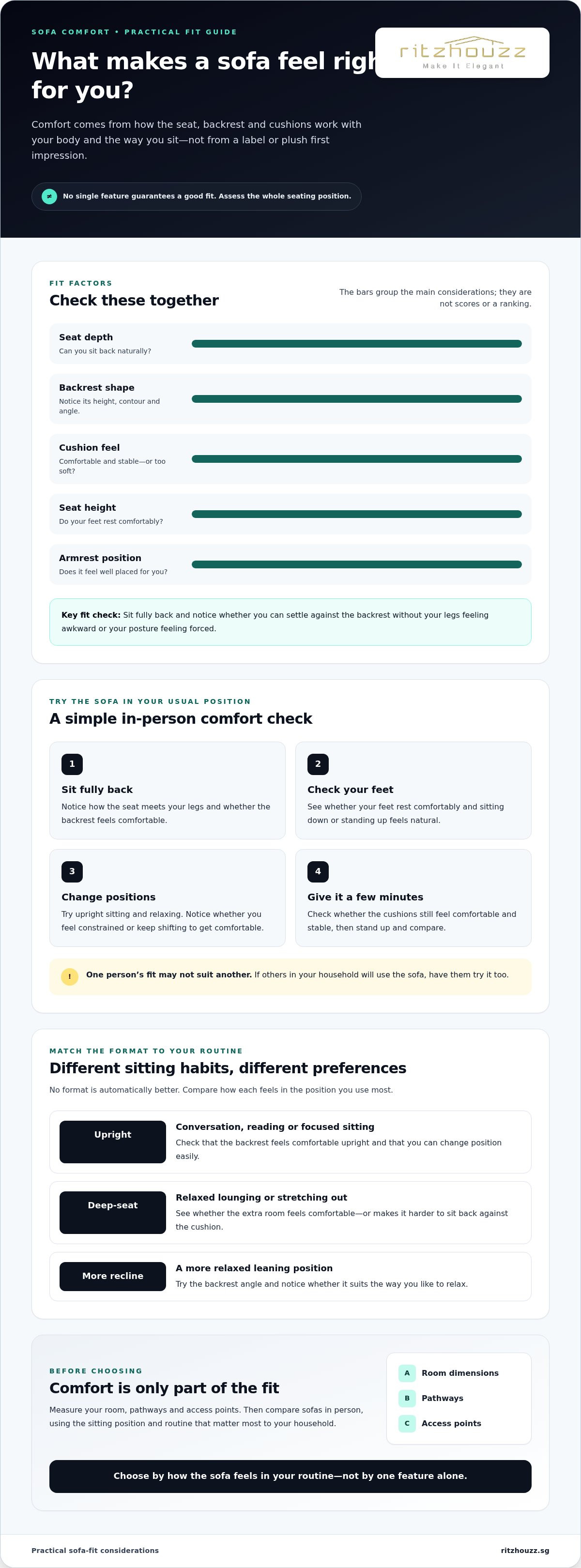
Assess seat depth and backrest contact together: the seat should let you settle against the backrest without making your legs feel awkward or your posture feel forced. This is a personal fit check, not a fixed measurement that suits every sitter.
How to judge sofa seat depth and seat height
Sit fully back, then notice where the seat meets your legs and whether you can stay comfortable in your preferred position. If the seat feels too deep for upright sitting, you may find yourself leaning forward or adding a cushion behind you. A shallower seat may feel more suitable for conversation, while someone who likes to lounge may prefer more room.
Check seat height as well. Notice whether your feet rest comfortably and whether standing up feels natural for you. The ergonomic sitting posture guidelines from the Canadian Centre for Occupational Health and Safety offer general sitting-position considerations, but use them as a reference rather than a sofa specification. Compare several designs in person, because a product label cannot tell you how the proportions will feel for your body.
How backrest shape and cushion feel affect daily use
Backrests vary in height, contour and angle. An upright shape may suit reading or conversation, while a more relaxed angle may appeal when you want to recline. Neither is automatically better. Consider whether the backrest feels comfortable in your usual position and whether you can shift posture without feeling constrained.
Pay close attention to the cushions, too. Sit for a few minutes and notice whether the surface feels comfortable and stable or whether you sink more than you prefer. Change positions and stand up. A cushion that feels inviting at first may not suit you if you keep adjusting to find a comfortable place to sit. If others in your household will use the sofa, have them try it as well. Their preferred posture and proportions may differ from yours.
Use these observations to compare sofas in different styles. Choose based on how each feels in your routine, rather than on one feature alone.
Ergonomic sofa comparison: match the design to your sitting habits
The right sofa format depends on what you do while seated and how much room you have. An ergonomic sofa for back support and comfort is not defined by one shape. Compare designs by how they feel in your usual positions, then consider whether each fits your room and household routine.
| Sofa format | May suit | What to assess |
|---|---|---|
| Upright | Conversation, reading or focused sitting | Does the backrest feel comfortable as you sit upright, and can you change position easily? |
| Deep-seat | Relaxed lounging or stretching out | Can you sit back comfortably, or does the depth make you want to add support behind you? |
| Recliner | Resting in a more laid-back position | Do you like the reclined position, and is there enough room for the sofa’s movement and placement? |
| Modular or L-shaped | Flexible seating or gathering with household members | Does the arrangement suit conversation while leaving clear circulation through the room? |
| Sofa-bed | Seating that can also serve as a sleeping surface | Does it work for everyday sitting, and can the room accommodate it when opened? |
Which sofa format suits reading, conversation or reclining?
Upright seating may feel natural for conversation or reading, while a recliner or deeper seat may better match a routine that includes resting or stretching out. Neither format is automatically more comfortable. Modular and L-shaped sofas can shape how people gather, but their layout also affects movement around the living room, especially in a compact HDB flat or condo.
Separate the decision into two checks: first, assess sitting comfort; then, assess room fit. Measure the sofa’s intended footprint and consider walkways, nearby furniture, and the space needed to use a recliner or open a sofa-bed. General ergonomic seating principles discuss features such as seat depth and backrests for office chairs. Use them to prompt useful questions, but judge sofa comfort in person.
How to compare sofa options without relying on marketing labels
Use the same checks on each sofa. Notice how the backrest meets you, whether the seat depth suits your preferred posture, how the cushions feel and how easily you can shift position. Make a note of which position felt comfortable and for which activity, such as reading, conversation or lounging. This gives you a more useful comparison than relying on labels like “supportive” or “relaxed”.
Explore RitzHouzz’s sofa collection, including the Aura 87211 Sofa as one option. Assess it as you would any model: consider its fit and feel for your own routine rather than assuming specific support features.
How to test an ergonomic sofa and check it fits your home
A sofa can feel inviting in a showroom yet prove awkward for your everyday routine or room layout. Assess comfort and fit separately. First, consider how it feels to sit on. Then check whether it can be positioned and accessed comfortably at home. These checks are useful when choosing an ergonomic sofa for back support and comfort for an HDB, BTO, resale flat or condominium.
A practical showroom test for sofa support and comfort
Try each option in the positions you expect to use at home, rather than sitting briefly for a first impression. Repeat the same checks on every sofa:
- Sit naturally. Settle into your usual posture, whether that means sitting upright for conversation or leaning back to relax.
- Sit fully back. Notice how the backrest meets you and whether the seat depth lets you remain comfortable without shifting forward.
- Change positions. Move from upright sitting to a more relaxed position. Pay attention to cushion feel and stability, and how easily you can move.
- Consider everyday use. Picture reading, chatting with family or resting, and note which positions feel comfortable for each activity.
Keep a short note for each sofa: what felt comfortable, what felt restrictive and which activity you had in mind. If other household members will use it, invite them to try the same positions. Their preferences may differ, so consider how the sofa works for the people who will sit on it most.
Measure the room and consider everyday access
Measure the area where you plan to place the sofa, then consider walkways, nearby furniture and the clearance needed for doors to open. Check the route into your home, including entrances and shared building access such as lifts or stairways. A sofa that fits the living room plan still needs to pass through the access points on the way there.
Bring your room measurements and layout notes when comparing options. In compact HDB or condominium living rooms, sofa placement can affect circulation. For a BTO or resale flat, consider how the sofa will sit alongside existing furniture and everyday movement through the space.
Visit the RitzHouzz showroom to compare sofa options in person and see which feels right for your routine. You can also enquire about sofa options with your measurements and preferred sitting positions in mind.
Find a comfortable sofa that suits your home and routine
Choosing well means combining what you learn from sitting tests with the practical needs of your household. Consider which positions feel natural, which activities matter most and whether the sofa’s proportions work in your room. An ergonomic sofa for back support and comfort is a personal fit: the right choice is one that feels comfortable in use and suits the space it will occupy.
Turn your comfort preferences into a clear sofa shortlist
Start with your everyday routine. If you often read or chat with family, prioritise how the sofa feels when you sit upright. If you tend to stretch out to rest, compare deeper seating or a recliner. In a shared living room, have household members try the options too, since their preferred posture may differ from yours.
Use what you observed, not labels alone. Note whether you could settle against the backrest, how the cushions felt and whether changing position was easy. Then check your room measurements, including walkways and access points, before choosing a style or configuration. This helps you balance comfort with how you move through your home.
Explore sofa options with RitzHouzz
RitzHouzz offers sofa options including the Aura 87211 Sofa, as well as custom furniture choices. Consider each model against your own preferences; its name or appearance cannot tell you how its proportions will feel. Compare formats in the RitzHouzz sofa collection, and use your notes and measurements to guide your choice.
A shortlist based on posture, daily use, room layout and access gives you a clearer way to compare options, whether you are furnishing a compact HDB living room or a more open condominium space.
Enquire about sofa options and discuss your comfort preferences with your preferred sitting positions, household needs and room measurements in mind.
Choose a sofa that feels right in your home
Choose by weighing how a sofa feels against how it will work in your room. Compare seat depth, backrest contact and cushion feel in the positions you use most, then check measurements, pathways and access before deciding. An ergonomic sofa for back support and comfort is a personal fit, not a medical promise or a feature determined by a label alone.
RitzHouzz offers fabric, leather, recliner, L-shaped, modular and sofa-bed options, along with custom furniture choices. The Aura 87211 Sofa is another option to consider as you compare your preferences, without assuming any particular ergonomic specification.
Share what matters to you, such as your preferred sitting positions, household routine and room measurements. Enquire about sofa options and discuss your comfort preferences with the RitzHouzz team. A considered comparison can help you find a sofa that feels at home in your space.
Frequently Asked Questions
What makes a sofa ergonomic?
An ergonomic sofa suits the sitter’s proportions, preferred posture and everyday use. Consider how the seat depth and height work with your legs, whether the backrest meets you comfortably and how the cushions feel as you sit and move. No single shape or marketing label guarantees a good fit. A sofa that feels comfortable for upright conversation may feel different from one chosen mainly for lounging.
Can a sofa provide back support and still feel comfortable?
Yes. A sofa can feel supportive while remaining comfortable if its backrest, seat and cushions suit the way you sit. “Back support” describes a seating experience, not a medical benefit or treatment. Try sitting naturally, settling against the backrest and changing position. An ergonomic sofa for back support and comfort should suit your preferred activities rather than force you into a fixed posture.
How do I choose the right sofa seat depth?
Choose seat depth by sitting fully back and noticing whether you can remain comfortable in your usual posture. If you prefer upright sitting, a seat that feels too deep may make you lean forward or want extra cushioning behind you. If you often lounge, more depth may feel appealing. Compare sofas in person, since body proportions and preferred sitting positions vary, and labels alone cannot show how a seat will fit you.
Is a firm sofa better for back support?
Not necessarily. Firmness is a personal preference, and a sofa that feels very firm to one person may feel uncomfortable to another. Focus on whether the cushions feel stable and comfortable for your intended use, and whether you can change position easily. Try the sofa rather than relying on a firmness description alone. Back support depends on the overall fit of the seat and backrest, not simply how firm the cushion feels.
What should I check when testing a sofa in a showroom?
Sit in the positions you expect to use at home, such as reading upright, talking with others or leaning back to rest. Sit fully against the backrest, notice how the seat meets your legs, and assess cushion comfort and stability. Then change position and stand up. Repeat the same checks on each sofa so you can compare how it feels for the activities that matter to you.
How do I know whether a sofa will fit my HDB or condominium living room?
Measure the planned sofa area and consider walkways, nearby furniture and the space needed to open doors or use a recliner or sofa-bed function. Also check the route into your home, including entrances, lifts and stairways where relevant. These checks matter in HDB flats, BTO and resale homes, as well as condominiums, where room layouts and access points can affect which sofa size or configuration is practical.
Can I choose a sofa for back support based on photos alone?
Photos can help you compare appearance and understand a sofa’s general shape, but they cannot tell you how its seat depth, cushion feel or backrest contact will suit your body. Use product information and measurements to shortlist options, then try them in person. Sitting naturally and changing position gives you a clearer sense of comfort. Check the room dimensions and access route before making a final choice.
Disclaimer
The information in this article is provided for general guidance only and is intended to help readers make informed decisions about mattresses, furniture, renovation, carpentry and related home solutions. Product specifications, prices, promotions, availability, warranties and services may change without notice. Actual colours, materials, dimensions and comfort may vary from images or descriptions. For renovation, carpentry or space-planning projects, final recommendations, measurements, scope of work and quotations should be confirmed directly with RitzHouzz before proceeding. Mattress comfort and suitability are subjective, and any health-related information is general in nature and should not be treated as medical advice. Please contact RitzHouzz or visit our showroom for the latest product and service information.