

Child-Safe Furniture Considerations for Singapore Homes in 2026
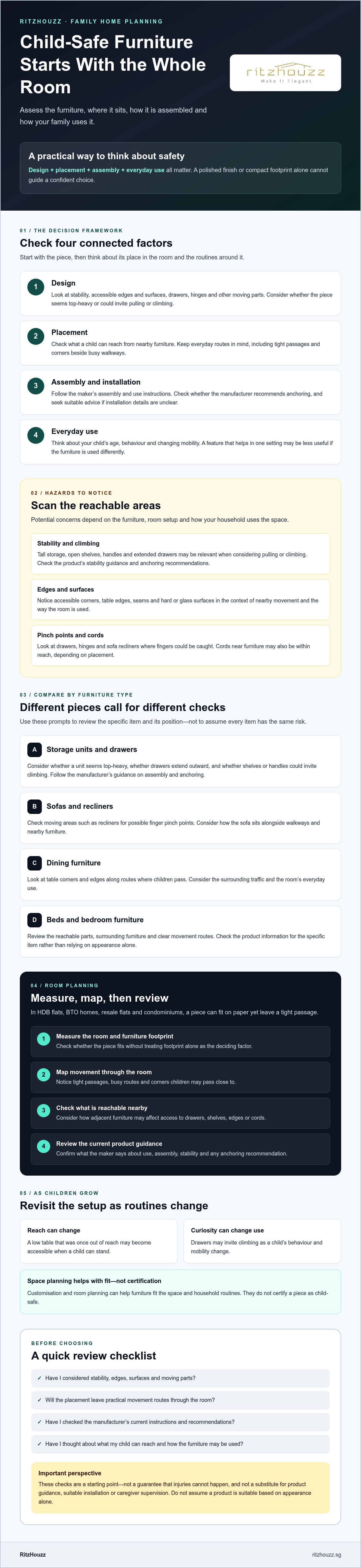
What makes a piece of furniture child-safe: its design, its position, or the way your family uses it? In practice, child-safe furniture considerations involve all three. A polished finish or compact footprint alone is not enough to guide a confident choice.
It is understandable to worry about tall furniture tipping, sharp edges, drawers or hinges catching little fingers, and whether a room will still feel usable when safety is part of the plan. These concerns can be especially relevant in HDB flats, BTO homes, resale flats and condominiums, where furniture needs to fit the available space as children grow.
This guide explains what to assess before buying, from stability and moving parts to placement and room layout. You will learn how to compare furniture types and plan practical pathways, then use specific questions to check product information. With careful measurements, furniture selection and space planning can be considered together, without assuming that any particular piece has child-safety features.
Key Takeaways
- Assess furniture safety through design, placement, assembly and everyday use, rather than relying on one feature or label.
- Before choosing storage furniture, check its stability and moving parts, and follow the maker’s assembly and anchoring guidance.
- Use these child-safe furniture considerations to compare sofas, dining furniture, storage pieces and beds according to how your household uses each space.
- Measure rooms, map movement and identify potential hazards before reviewing product guidance for living, dining and bedroom areas.
- Consider how routines and room needs may change as children grow. Customisation and space planning can help furniture fit, but do not certify it as child-safe.
What child-safe furniture considerations matter before you buy?
Start with the piece, then consider where it will sit and how your family will use it. A tall storage unit near a child’s play area calls for different checks from a sofa or dining chair. In a compact home, look at clear pathways as well as the furniture footprint. A piece may fit on paper but leave a tight passage where children could bump into corners or trip.
Child-safe furniture is furniture chosen and set up with foreseeable risks in mind, not a promise that injuries cannot happen. Practical risk reduction depends on design, placement, correct assembly and ongoing supervision. A feature that helps in one setting may be less useful if the furniture is positioned differently or used in a way the maker did not intend. Furniture is one part of childproofing your home, alongside choices about the wider environment.
What does child-safe furniture mean in a family home?
Think of safety as a series of checks, not a label. Look at stability, reachable moving parts, edges and surfaces, then consider whether the furniture suits the room and your household’s routines. Before relying on a product-specific claim, review the current manufacturer information and check exactly what the claim covers. RitzHouzz offers sofas, dining furniture, bedroom furniture and customisation, but features need to be confirmed for each specific piece.
Which everyday furniture risks should caregivers consider?
Potential risks vary by furniture type and room setup. A child may pull on drawers or try to climb a storage unit. Sofa recliners and drawers have moving areas where fingers could be pinched, while sharp table corners may be a concern beside busy walkways. Cords near furniture may also be within reach, depending on the room. These possibilities do not mean every item carries the same risk.
Consider your child’s age, behaviour and changing mobility. A low table that was once out of reach may become accessible when a child can stand. Drawers may also invite climbing as curiosity grows. Check the maker’s instructions for assembly and use, including any recommendation to anchor the furniture. Do not assume a product is suitable based on appearance alone.
- Stability: Consider whether a piece seems top-heavy or could be pulled or climbed on.
- Edges and surfaces: Check accessible corners, seams and finishes for concerns relevant to your child.
- Moving parts: Identify hinges, recliners and drawers that could create pinch points.
- Placement: Keep everyday routes clear and consider what a child can reach from nearby furniture.
Use these checks as a starting point, not a substitute for product guidance, suitable installation or caregiver supervision.
How do stability, edges and moving parts affect furniture safety?
Stability and accessible features deserve close attention because children may pull, lean on or climb furniture as they explore. A tall storage unit may be less stable if a child uses open shelves or drawers as steps. Before buying, consider how the item is designed, how it will be used and whether the manufacturer recommends anchoring it. The U.S. Consumer Product Safety Commission’s Anchor It! campaign offers public guidance on furniture and TV tip-over prevention. For any item you choose, follow its own manufacturer instructions.
How can buyers assess tip-over and climbing risks?
Consider whether the furniture appears top-heavy, whether drawers extend outward, and whether shelves or handles could invite climbing. These observations cannot confirm how stable a product is. Check the manufacturer’s current product information for stability guidance, anchoring recommendations and assembly instructions. Do not choose fixings or an installation method based on appearance alone.
Installation guidance depends on the furniture and wall conditions. The correct approach can vary with the product and the surface it will be secured to. Use the supplied instructions and seek suitable advice if anything is unclear.
What should you check on edges, drawers and moving furniture?
Check the areas a child can reach during ordinary use. Inspect corners along walking routes, drawer fronts and handles, hinges, and other places where fingers could be caught. Consider how a dining table, sofa or storage unit sits within the room, especially where children may pass close to furniture.
Consider glass and other hard surfaces in context. Note their location, surrounding traffic and how the room is used, then check product information for relevant details. Do not assume that a particular material or finish is safer without verified product guidance.
Foldable, reclining or convertible furniture needs an additional check. Read the operating instructions, identify where parts move, and keep the movement area clear when the furniture is opened, closed or adjusted. If children are nearby, consider whether they can reach the mechanism during normal use.
- Before purchase: Ask about stability, accessible mechanisms and any recommended anchoring.
- Before use: Confirm that assembly and operation follow the manufacturer’s instructions.
- In the room: Check edges and moving zones against your family’s actual pathways and routines.
These practical child-safe furniture considerations can help you ask more precise questions when comparing pieces. If you are assessing a sofa or dining furniture, send RitzHouzz your furniture questions and confirm product-specific details before deciding.
Does child-safe furniture guarantee safety? Compare features by furniture type
No. A furniture label or individual feature cannot make every household situation risk-free. A rounded corner, locking drawer or anchoring point may address a particular concern, but suitability still depends on the product, its setup, the room layout and how your household uses it. Treat child-safe furniture considerations as product-specific questions, not a pass-or-fail label.
Use this comparison to decide what to ask about each piece. Confirm the answers against current manufacturer information rather than assuming that all items in a category share the same features.
| Furniture type | Potential concern to assess | Questions and information to verify |
|---|---|---|
| Sofas | Stability, accessible gaps and reclining or convertible mechanisms | Does the maker provide guidance on use and moving parts? Are gaps or mechanisms reachable in your room’s arrangement? |
| Dining furniture | Table stability, sharp corners and chairs that move during everyday use | How does the table sit on your floor? Are corners beside a busy route, and can chairs be positioned without obstructing pathways? |
| Storage furniture | Climbable drawers or shelves and potential tip-over | Does the manufacturer recommend anchoring? What assembly and installation instructions apply? |
| Beds | Frame stability, accessible moving parts and, for wall beds, operation and movement zones | What does the maker specify for assembly, use and clearance? Which instructions apply to the exact bed model? |
Which checks matter for sofas and dining furniture?
For a sofa, consider how it sits on the floor and whether a child could reach gaps, recliner controls or convertible sections. The relevant questions vary by design, so review the maker’s product details and operating instructions. Browse the sofa collection while noting which features you will want to verify for a specific model.
For dining furniture, look beyond the table’s appearance. Check how stable it feels in its intended position, whether corners sit beside a main walkway, and how chairs move when pulled out or pushed in. In a compact dining area, make sure there is room to use the chairs without creating a tight passage.
What should families check on beds and storage furniture?
For bed frames and storage pieces, check stability, drawers or other moving parts, assembly guidance and any manufacturer recommendations for anchoring. Wall beds need particular attention to their own operating and clearance instructions. General child-safety advice cannot replace guidance for the specific model. If you are researching Murphy bed safety and space planning, verify the product’s requirements before deciding how it fits your room.
How can you use a room-by-room checklist before choosing furniture?
A measured plan helps you judge how a piece will fit into family life, not just whether it fits on paper. This is useful in HDB, BTO and resale flats, as well as condominiums, where room layouts and pathways differ. Work through the same steps for each space, then confirm product-specific details before deciding.
- Measure the room: Note the available floor area, doorways and the space the furniture needs when opened or in use.
- Map movement: Mark routes between entrances, seating, dining areas and beds. Allow for chairs or drawers to move as intended.
- Identify hazards: Consider what a child can reach, climb on or operate, and where sharp edges or moving parts sit in relation to everyday activity.
- Check product guidance: Review the maker’s current information for assembly, use, anchoring recommendations and any operating clearances.
What should you check in living and dining areas?
In the living room, sketch the sofa and storage furniture into your plan, then check whether the arrangement leaves clear routes through the space. Note accessible drawers, climbable surfaces and any reclining or convertible mechanisms. For a dining area, include the table and chairs in their pulled-out positions. This can show whether seating blocks a pathway or places a corner in a busy route.
Furniture dimensions alone do not show how a room functions. Compare possible placements on a measured plan before purchase, and consider how your family usually moves through the space.
How should families review bedrooms and compact layouts?
In bedrooms, measure the bed and storage furniture together, then check access around them in the planned arrangement. Consider whether drawers can open without obstructing a route and whether a child can reach furniture in ways that may invite climbing. For a wall bed or convertible piece, review the model’s instructions and required movement area before planning its position or use.
As children grow, routines and access can change. Revisit the layout rather than assuming an arrangement that works now will remain suitable. These child-safe furniture considerations can guide the questions you bring to a furniture enquiry.
Before asking about furniture options, prepare room measurements, a floor plan if available, and questions about relevant product guidance. Share your measurements and furniture requirements with RitzHouzz to discuss how furniture selection and space planning can be considered together.
How can you choose furniture that adapts as children grow?
Choose with more than today’s routine in mind. A bedroom may later need a study area, a living room may serve several purposes, and a child’s reach and independence will change over time. Consider how each room is used now, how that use could shift, and whether the furniture will still suit those needs. Adaptability can help with planning, but it does not certify a piece as child-safe.
When should you consider customisation or space planning?
Custom furniture may be worth considering when standard pieces do not suit the measured room or the way your household needs to use it. In a compact HDB, BTO or condominium layout, consider dimensions and placement together so a new piece works with existing routes and room functions. RitzHouzz offers furniture customisation and space-planning services to help with fit, but product safety details still need to be checked separately.
Prepare room dimensions, a floor plan if available, and a brief description of how you intend to use the furniture. If a piece has drawers, moving parts or more than one configuration, note how and when your family expects to use it. These details can clarify what to assess when discussing home space-planning considerations.
What questions should you ask before making a final choice?
Keep your questions specific to the furniture you are considering. Ask what product information is documented, where to find the current operating instructions, and what assembly or installation requirements apply. If the manufacturer makes a safety-related claim, ask which exact feature or use it refers to and request the supporting product information. Do not rely on a general verbal assurance instead of details you can check.
- What are the piece’s dimensions, and how will it fit the room’s intended use?
- Which features, materials or mechanisms are confirmed in the product information?
- What assembly, operating or installation instructions should be followed?
- Could changing routines affect access, movement or how the furniture is used?
Keep the answers with your measurements and revisit them if the room or household routine changes. A considered approach to child-safe furniture considerations helps separate questions about fit from product-specific safety claims.
For a furniture enquiry, contact RitzHouzz with your room measurements, intended use and product questions. You can discuss relevant furniture options and space planning, while confirming specific safety features against the manufacturer’s information.
Choose thoughtfully for the home you have and the family you’re becoming
Good child-safe furniture considerations begin with how a piece will function in your home, not with one label or feature. Check the manufacturer’s guidance for the specific item, and use room measurements to assess how furniture fits your family’s routines now and as they change.
RitzHouzz offers furniture customisation, interior design and space-planning services to help households consider furniture and room fit together. These services can support a considered layout, but they do not certify a product as child-safe. Confirm product-specific safety details against the manufacturer’s information.
Bring your measurements and questions to the RitzHouzz showroom and discuss your furniture requirements. Seeing furniture in person and asking about relevant product details can help you make a more informed choice for your family’s home.
Frequently Asked Questions
Is child-safe furniture completely safe for children?
No furniture is completely risk-free in every home or situation. A feature may address a particular concern, but everyday risk also depends on placement, correct assembly, how the item is used and caregiver supervision. Treat child-safe furniture considerations as practical checks, not a guarantee. Review current manufacturer information for the specific piece, and consider whether it suits your child’s age, behaviour and access to different parts of the room.
How can I stop furniture from tipping over?
Start by checking the manufacturer’s assembly, use and anchoring instructions for the specific item. If anchoring is recommended, follow the supplied guidance and consider the relevant wall conditions. Do not choose fixings or an installation method based on appearance alone. Also consider whether open shelves or drawers could invite climbing, and avoid placing tempting items where they encourage a child to reach higher. Recheck the furniture if its position or use changes.
What furniture should I avoid with young children?
There is not one furniture type that every family must avoid. Instead, assess how a particular piece could be used in your home. For example, consider whether storage furniture appears top-heavy, whether drawers or shelves invite climbing, or whether a recliner or convertible item has accessible moving parts. Think about your child’s age, behaviour and mobility, then check the manufacturer’s instructions and product details before deciding.
Are rounded furniture corners safer for children?
Rounded corners can reduce exposure to sharp edges, but they do not make a piece risk-free or establish that it is suitable for every child or room. Consider where the furniture will sit, whether children move past it during play, and what other accessible features it has. Check the product’s actual design and manufacturer information rather than relying on a general description such as “child-friendly” as proof of safety.
Are glass tables suitable for homes with children?
Suitability depends on the specific table, its placement and how the room is used. Consider the table’s location in relation to walkways and play areas, surrounding traffic, and the manufacturer’s information about its materials and intended use. Do not assume all glass tables are unsuitable, or that a particular construction is safe without verified details. If you are uncertain, ask the seller for product-specific documentation before buying.
What should I check before buying a bed or storage furniture for a child’s room?
Check stability, accessible drawers or other moving parts, assembly instructions and any anchoring recommendations. For beds, consider access around the frame and how the furniture fits the room’s pathways. For storage furniture, look at whether shelves or drawers could invite climbing. Review current manufacturer guidance for the exact product, and ask for details in writing if an important feature or installation requirement is unclear.
Can custom furniture be made child-safe?
Custom furniture can be planned around room measurements and intended use, but customisation alone cannot certify a piece as child-safe. Discuss the design, accessible edges, moving parts, stability and installation requirements, then ask which details can be confirmed in product documentation. RitzHouzz offers furniture customisation and space planning, but any safety-related claims should be verified for the specific design against its manufacturer information.
Disclaimer
The information in this article is provided for general guidance only and is intended to help readers make informed decisions about mattresses, furniture, renovation, carpentry and related home solutions. Product specifications, prices, promotions, availability, warranties and services may change without notice. Actual colours, materials, dimensions and comfort may vary from images or descriptions. For renovation, carpentry or space-planning projects, final recommendations, measurements, scope of work and quotations should be confirmed directly with RitzHouzz before proceeding. Mattress comfort and suitability are subjective, and any health-related information is general in nature and should not be treated as medical advice. Please contact RitzHouzz or visit our showroom for the latest product and service information.